Ouch! An entire week since my last posting? I hope to fix that this week with some thoughts on kids and abstract themes, plus another review. But the weekend was nice - other than Kansas State being exposed by the dreaded Sooners. Oh well, still another great rebuilding tenure under Snyder's second commandership in the Little Apple.
We got in a 4-player session of Citadels for the first game of the weekend. I prefer the 5- or 6-player versions. With only 4 players, there is an extra character laid down before the draft. While that might not seem like a major deal, it still narrows the guessing mechanic - especially for the first player who might choose the Assassin and/or Thief and then know right away the only four characters left. And say they do choose the Assassin, and then one of the last four is the Thief, well now there are only three characters that they have to pick from to attack. That can be quite an advantage! But I'll admit it does add a good deal of tension to the variant.
I played two 2-player sessions of Dominion, one with my brother-in-law from Green Bay who was in town with family. I've mentioned introducing the game to him previously and he's a natural at it with his hardcore Pokémon background. We both had the samd idea in going after the Village, Festival, and Market fairly heavy, but I spent a couple turns on the Bureaucrat, as well. Unfortunately, the free Silvers provided little advantage. In the end, he was able to nab one extra Province that proved the difference.
Then all of the kids and I took on Lifeboat to end the weekend. I think the kids were tired from playing with their cousins and staying up late the two nights before, because they were more sensitive than usual to the ganging up and back-stabbing. Tempers flared in this session and I almost had to end the game early! But that is not usually the case. We were able to finish amicably in the end. I hated myself and so tried early on to take out everyone else, starting with the big First Mate (Lilly). However, since I was the weakest character, Lady Lauren, it was tough going and included a lot of bribery. My one advantage was that the First Mate was my secret love, so I knew other people wouldn't be rushing to his (her) aid. Unfortunately, she had the flare gun which added another 8 points of strength making her virtually untouchable. On top of that, she had the parasol which protected her from one thirst every round. As I was Lady Lauren, I managed to grab all the jewels which gave me double points for them - diamonds are a girl's best friend! But it was Hope, the next weakest with Sir Stephen, who just quietly rowed all game long and saved up paintings (his double points), and won the game. I think this was the first game of Lifeboat we've played in which everyone survived - and remained conscious even!
October 31, 2011


October 25, 2011
Gaming Report: Dominion, Mag Blast
Seems like we have a routine around here – which is logical as you need one when raising seven kids! The weather was gorgeous, again – I can't believe it was the "Third Saturday in October" (go Vols!), and yet it was 73 degrees! So we enjoyed football and bikes and trampoline and other things outside. We only snuck in a few quicker games inside.
I played Dominion with the boys. This game is a really nice fit for my kids, in particular, because of their background and enjoyment with Pokémon. For those familiar with that collectible card game, my kids really appreciate that there is no number limit on a single card in Dominion. Many times when putting a Pokémon deck together, they wish they could include more than four of some cards. With Dominion, they can just go after whatever they want, regardless of the number of copies already in their deck. But then again, this leads them to loading up on particular favorites and tardy acquisitions of Victory cards. Therefore, perhaps a single card limit would be of benefit in teaching how to balance your deck?
I also got in a few games of Mag Blast with Lilly. She's really taken a shine to this mad-cap gem. I like it because it is quick to set-up, play, and break down. It takes up little space (well, certainly a two-player session). Plus it requires relatively little concentration – so we can play on the floor while I watch football. For some reason, Lilly is extremely unlucky at this game. At least I don't think I can chalk up all my victories to skill, given the nature of the game, but I routinely destroy her and really have no explanation as to why. The fact that she keeps requesting to play, then, I feel is testament to the title's enjoyability.
On a concluding note, I hope to expand these gaming session "reports" in the very near future by including a few shots of our games in progress and some further thoughts from the kids. Maybe have them give it a go at writing some reports, as well...
I played Dominion with the boys. This game is a really nice fit for my kids, in particular, because of their background and enjoyment with Pokémon. For those familiar with that collectible card game, my kids really appreciate that there is no number limit on a single card in Dominion. Many times when putting a Pokémon deck together, they wish they could include more than four of some cards. With Dominion, they can just go after whatever they want, regardless of the number of copies already in their deck. But then again, this leads them to loading up on particular favorites and tardy acquisitions of Victory cards. Therefore, perhaps a single card limit would be of benefit in teaching how to balance your deck?
I also got in a few games of Mag Blast with Lilly. She's really taken a shine to this mad-cap gem. I like it because it is quick to set-up, play, and break down. It takes up little space (well, certainly a two-player session). Plus it requires relatively little concentration – so we can play on the floor while I watch football. For some reason, Lilly is extremely unlucky at this game. At least I don't think I can chalk up all my victories to skill, given the nature of the game, but I routinely destroy her and really have no explanation as to why. The fact that she keeps requesting to play, then, I feel is testament to the title's enjoyability.
On a concluding note, I hope to expand these gaming session "reports" in the very near future by including a few shots of our games in progress and some further thoughts from the kids. Maybe have them give it a go at writing some reports, as well...
October 21, 2011
Board Game Review: Red November
Red November (Fantasy Flight/Bruno Faidutti & Jef Gontier, 2008)
1-8 players / 12 + / 60 minutes
"Captain," exclaimed the frantic helmsgnome. "We are dangerously approaching the depth limits of our hull rating. Any further descent I fear will crush us!"
"Send Baturin to the Engine Room for repairs immediately!"
"Sorry, sir, he's trapped in the crew's quarters - all hatches blocked!"
"Well, man, then send Gusyeva!"
"Sir, he's going to rescue Baturin."
"For the love of Mother Gnomia! Then Shvakova?"
"Putting out a fire in the Reactor Room, sir."
"Voronov?"
"Uh," the helmsgnome hesitated, "he's passed out."
"Fine, then you, Mayorsky, shall repair the engines."
"Sir! You've already ordered me to the Oxygen Pumps" Then pulling a mangled book from his tunic, "I even have my manual, see!"
Standing at a dignified attention, "Very well, Mayorksy, I shall see to it personally!"
The captain marched to the hatchway but was interrupted with startled alarm. "Sir! It's the Kraken!"...
What You Get:
Compact components that pack quite a wallop! While this second printing comes with a larger board and in a larger box than the original Silver Line run, it's all still undersized, though functional. The gnome figurines are pliable and cute. The cards are downright tiny, with print smaller than I'd personally like, but they work and are of good quality. You get a pile of nice sturdy cardboard tokens, plus three wooden cubes, to mark various problem areas on the sub, like fires, floods, and blocked hatches. Additionally, you get small, plastic "mini-thimbles" (which can stack neatly) that are used to mark your progression on the time track running around the edge of the board. Overall, the humorous artwork is almost perfectly thematic. While certainly gnomes are fantasy, the game's title still evokes a Russian image which is aptly conveyed through the artwork. I guess if you're like me, you'd struggle to adequately express what you imagine Communist gnomes on a Cold War era submarine would look like. But after seeing this game, you'll probably say, "That's it!"
The Quick Rundown:
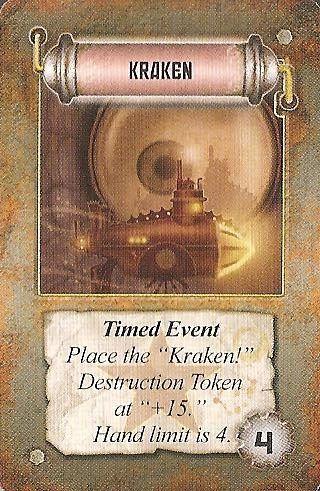
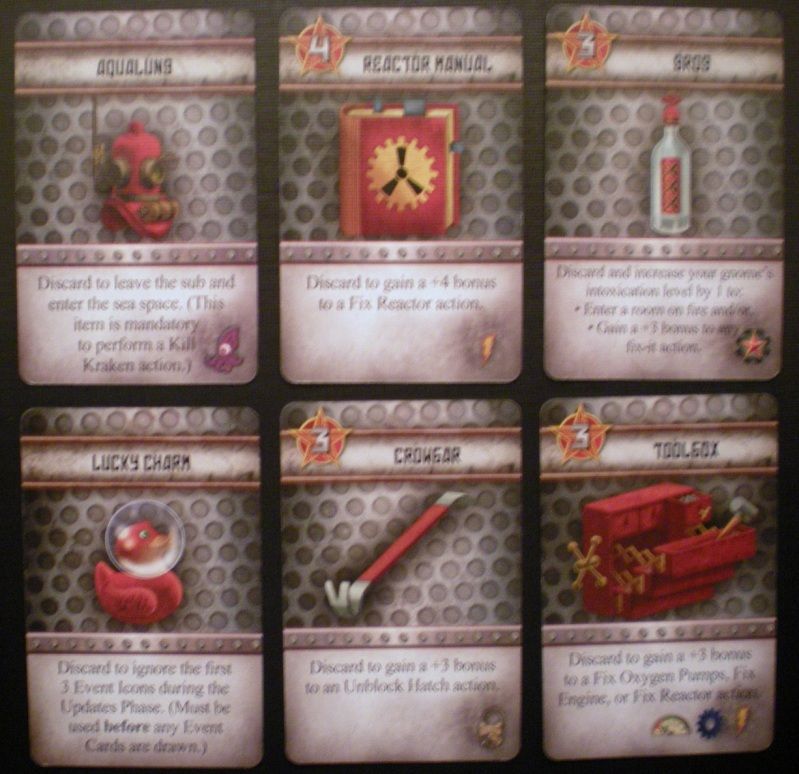
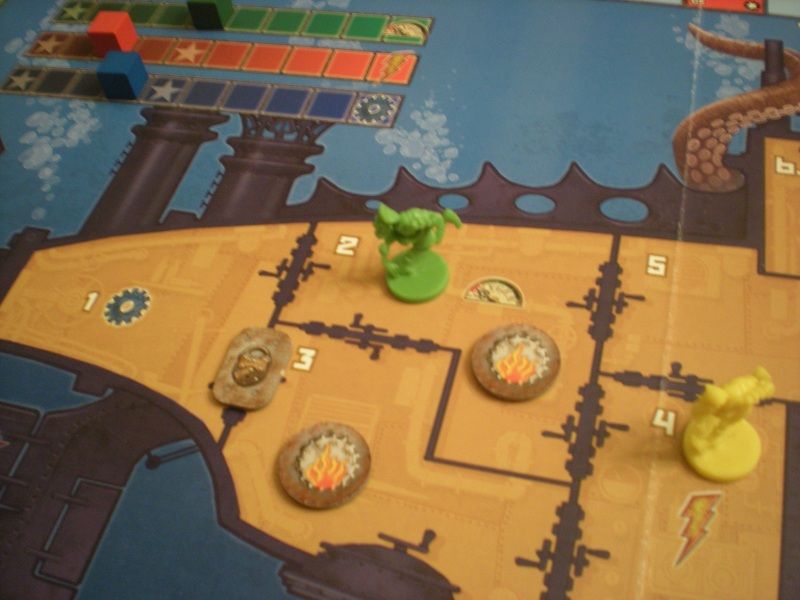 The object of Red November is for all gnomes to work together and survive for 60 minutes on the game's time track. The problem is that the submarine seems to have been developed by the same people responsible for such other brilliant ideas like New Coke, trickle-down economics, Windows Vista, The Backstreet Boys, and whoever drafted Todd Blackledge over Dan Marino (oh, yeah, that was the Chiefs...grrrrr!). Or in other words, it is the worst piece of engineering since the automatic seatbelt. Just about every minute some malfunction, or other near catastrophe, threatens to doom the fated vessel and its submariners. In no particular order, you can explode, overheat, be crushed, asphyxiate, drown, burn, or be eaten by a Kraken. Everything you do takes time. As time passes, events happen that are usually bad. Fixing those takes more time which means, well, you get the idea. To accomplish damage control, you must move your gnome to the affected section (one minute per room) and then decide how many minutes, from 1-10, you'd like to gamble on trying to fix or repair the problem. You then toss a d10 hoping to roll that number or less - otherwise you failed to fix it. You are allowed to acquire and carry a number of items that may give you bonuses to those times and most of them are specific to certain problems. (For example, the Deactivation Code gives you a +4 when trying to shut down a missile malfunction. If your gnome is in the missile room and you gamble 4 minutes on trying to fix it, you'd have to roll an 8 or less.) As each gnome advances his marker around the time track, he will have to draw new event cards at various points along the way. So while you take the time to successfully fix one problem, two or three more could potentially spring! But if the boat survives to the end, everyone wins - except, of course, any cowardly comrades who might have slipped out the back hatch with an aqualung, abandoning their mates to their supposed doom.

E for Everyone:
Well, you know what they say: "The family that plays together, gets eaten by a giant, nasty Kraken together!" First off, Red November has the whole cooperative thing going for it on the family friendliness factor. As the adult, the main point I need to remember is not to "take over" the game by telling, or even always suggesting, which moves and actions my kids should take on their turns. They have done very well in analyzing needs and implementing solutions on their own. Now that may sound like fancy corporate-speak (and especially silly considering the crazy theme), but this game is actually a good problem-solving exercise. You have to decide which player is best able to respond to which danger based on his/her location, inventory, and position on the time track - all relative to the other players. It's very puzzle-like. While certainly basic, it is nonetheless a helpful skill to have in the real world. And I don't think that is too pretentious a statement to make. There is no whining and grumbling and finger-pointing in this one. Just a lot of laughs while planning how best to save the stricken craft together - and maintaining your sanity in the process!
Also, it has one of the most unique themes I've ever read about in hobby gaming. Interestingly, from my understanding, Faidutti and Gontier were sensitive to the connection between their game and the real life Kursk disaster and so were careful to retain the submarine theme while not making light of that tragedy. That makes for a fascinating point of discussion on the topic of theme and content in hobby gaming. But one that would not be adequately dealt with in a review. Nonetheless, theming the game with fantastical gnomes was part of that effort. Adding the Kraken further solidifies this voyage as "over-the-top." In any event, this title provides a refreshing game play that is unique from a lot of standard options.
That game play also creates a great deal of tension. It is the definition of chaos - and quite random, to boot! Playing is the equivalent to sitting on the edge of your seat when watching a scary movie. In tyring to risk the least amount of time to repair damage, you'll all be transfixed on the die rolls to see if you succeed at each effort. And every time you're required to draw an event card, you almost dread seeing what will go wrong next! Will it be a fresh problem relatively easy to address? Or one that compounds an existing issue? And in those rare moments when nothing bad happens, you feel a collective sigh of relief! This tension keeps everyone involved in the game to the very end, even if your personal gnome perishes (yes, player elimination is possible). Downtine is irrelevant. Time passes quickly - both game-wise and play-wise!
There are a couple of issues that throw a small wrinkle in the 'E' rating - one thematic, one mechanic. The thematic wrinkle is a small one and probably not a huge deal to most people, but I'll mention it: grog. Sure, that is certainly appropriate to the nautical motif, but this review is about game play and kids, after all. Grog in the game gives you two benefits. One it gives you "courage" to enter a compartment on fire - otherwise you need a fire extinguisher. I guess one can make a logical kind of argument there. In addition, it gives you a +3 bonus in fixing any problem, which is a little more difficult to explain regarding a substance that impairs judgement and motor functions! However the deleterious side effect is that each time you drink a grog, your inebriation level rises which increases the chances that you might pass out. Not only do you lose precious time while lying in your own drool doing nothing of benefit, but if you're unconscious in a room that catches fire or completely floods, you die. So in a twisted sort of way, there's an object lesson there for your kids about the dangers of alcohol!
The mechanic wrinkle is time track management. In short - it is confusing and fiddly. Your place on the track is marked with a corresponding colored marker. For every movement and action that takes time, you move a white "ghost" marker ahead the necessary number of minutes in front of you. Once your entire turn is complete, you move your marker forward one space at a time, drawing and resolving event cards at intermittent points along the track as indicated, until reaching the ghost marker. Then the next turn falls to the player furthest back in time, which could possibly be you again. Then there is the added element of "timed destruction events." If one of these cards are drawn, you place a token 10 minutes ahead of the point on the track at which it was drawn. If all gnomes pass this point before fixing the problem, the event destroys the ship and the game is immediately over. This entire element is confusing for kids and difficult to learn. Not that it could have been designed any differently - so it takes some getting used to. And not just for kids, either. I'm still not confident we are playing it 100% correct with all the various details to consider when managing the time track. The rulebook is not overly helpful, either, because it is poorly organized.
Okay, I'll Shut Up Now:
In the end, I give Red November an 8 on the Board Game Geek scale (Very good game. I like to play. Probably I'll suggest it and will never turn down a game.). The cooperative element and the over-the-top theme combine to create a funny and engaging experience that is on a different level than standard, competitive strategy games. The chaos and luck create a good tension that even kids under the recommended age rating should be able to navigate and enjoy trying to manage.
"Captain," exclaimed the frantic helmsgnome. "We are dangerously approaching the depth limits of our hull rating. Any further descent I fear will crush us!"
"Send Baturin to the Engine Room for repairs immediately!"
"Sorry, sir, he's trapped in the crew's quarters - all hatches blocked!"
"Well, man, then send Gusyeva!"
"Sir, he's going to rescue Baturin."
"For the love of Mother Gnomia! Then Shvakova?"
"Putting out a fire in the Reactor Room, sir."
"Voronov?"
"Uh," the helmsgnome hesitated, "he's passed out."
"Fine, then you, Mayorsky, shall repair the engines."
"Sir! You've already ordered me to the Oxygen Pumps" Then pulling a mangled book from his tunic, "I even have my manual, see!"
Standing at a dignified attention, "Very well, Mayorksy, I shall see to it personally!"
The captain marched to the hatchway but was interrupted with startled alarm. "Sir! It's the Kraken!"...
What You Get:
Compact components that pack quite a wallop! While this second printing comes with a larger board and in a larger box than the original Silver Line run, it's all still undersized, though functional. The gnome figurines are pliable and cute. The cards are downright tiny, with print smaller than I'd personally like, but they work and are of good quality. You get a pile of nice sturdy cardboard tokens, plus three wooden cubes, to mark various problem areas on the sub, like fires, floods, and blocked hatches. Additionally, you get small, plastic "mini-thimbles" (which can stack neatly) that are used to mark your progression on the time track running around the edge of the board. Overall, the humorous artwork is almost perfectly thematic. While certainly gnomes are fantasy, the game's title still evokes a Russian image which is aptly conveyed through the artwork. I guess if you're like me, you'd struggle to adequately express what you imagine Communist gnomes on a Cold War era submarine would look like. But after seeing this game, you'll probably say, "That's it!"
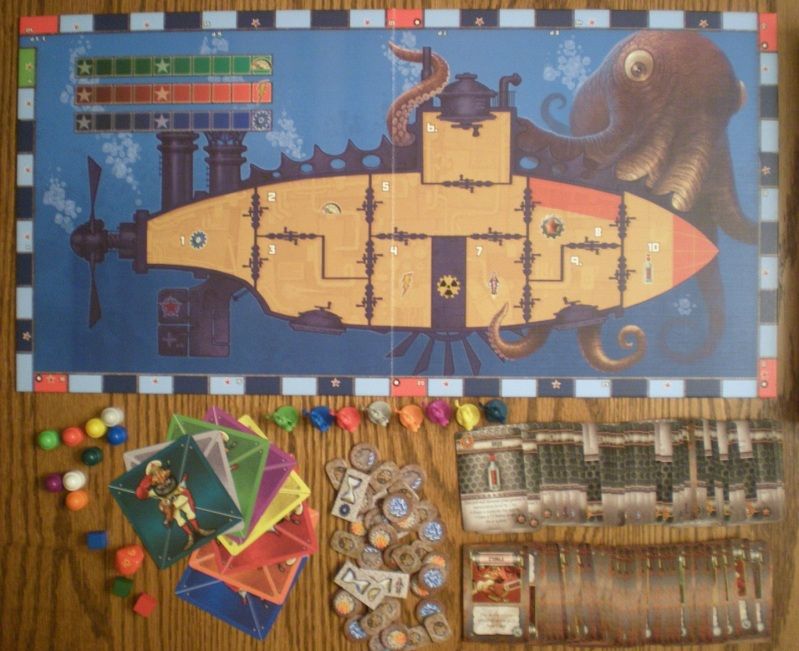 | |
| Board, cards, tokens, and pieces. |
The object of Red November is for all gnomes to work together and survive for 60 minutes on the game's time track. The problem is that the submarine seems to have been developed by the same people responsible for such other brilliant ideas like New Coke, trickle-down economics, Windows Vista, The Backstreet Boys, and whoever drafted Todd Blackledge over Dan Marino (oh, yeah, that was the Chiefs...grrrrr!). Or in other words, it is the worst piece of engineering since the automatic seatbelt. Just about every minute some malfunction, or other near catastrophe, threatens to doom the fated vessel and its submariners. In no particular order, you can explode, overheat, be crushed, asphyxiate, drown, burn, or be eaten by a Kraken. Everything you do takes time. As time passes, events happen that are usually bad. Fixing those takes more time which means, well, you get the idea. To accomplish damage control, you must move your gnome to the affected section (one minute per room) and then decide how many minutes, from 1-10, you'd like to gamble on trying to fix or repair the problem. You then toss a d10 hoping to roll that number or less - otherwise you failed to fix it. You are allowed to acquire and carry a number of items that may give you bonuses to those times and most of them are specific to certain problems. (For example, the Deactivation Code gives you a +4 when trying to shut down a missile malfunction. If your gnome is in the missile room and you gamble 4 minutes on trying to fix it, you'd have to roll an 8 or less.) As each gnome advances his marker around the time track, he will have to draw new event cards at various points along the way. So while you take the time to successfully fix one problem, two or three more could potentially spring! But if the boat survives to the end, everyone wins - except, of course, any cowardly comrades who might have slipped out the back hatch with an aqualung, abandoning their mates to their supposed doom. E for Everyone:
Well, you know what they say: "The family that plays together, gets eaten by a giant, nasty Kraken together!" First off, Red November has the whole cooperative thing going for it on the family friendliness factor. As the adult, the main point I need to remember is not to "take over" the game by telling, or even always suggesting, which moves and actions my kids should take on their turns. They have done very well in analyzing needs and implementing solutions on their own. Now that may sound like fancy corporate-speak (and especially silly considering the crazy theme), but this game is actually a good problem-solving exercise. You have to decide which player is best able to respond to which danger based on his/her location, inventory, and position on the time track - all relative to the other players. It's very puzzle-like. While certainly basic, it is nonetheless a helpful skill to have in the real world. And I don't think that is too pretentious a statement to make. There is no whining and grumbling and finger-pointing in this one. Just a lot of laughs while planning how best to save the stricken craft together - and maintaining your sanity in the process!
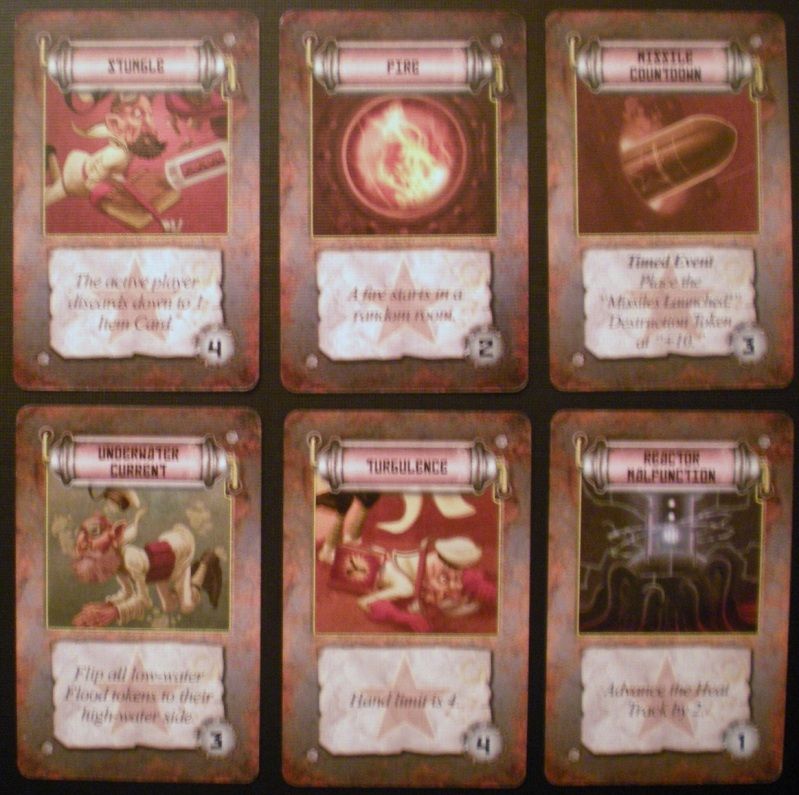 |
| Bad stuff can happen! |
That game play also creates a great deal of tension. It is the definition of chaos - and quite random, to boot! Playing is the equivalent to sitting on the edge of your seat when watching a scary movie. In tyring to risk the least amount of time to repair damage, you'll all be transfixed on the die rolls to see if you succeed at each effort. And every time you're required to draw an event card, you almost dread seeing what will go wrong next! Will it be a fresh problem relatively easy to address? Or one that compounds an existing issue? And in those rare moments when nothing bad happens, you feel a collective sigh of relief! This tension keeps everyone involved in the game to the very end, even if your personal gnome perishes (yes, player elimination is possible). Downtine is irrelevant. Time passes quickly - both game-wise and play-wise!
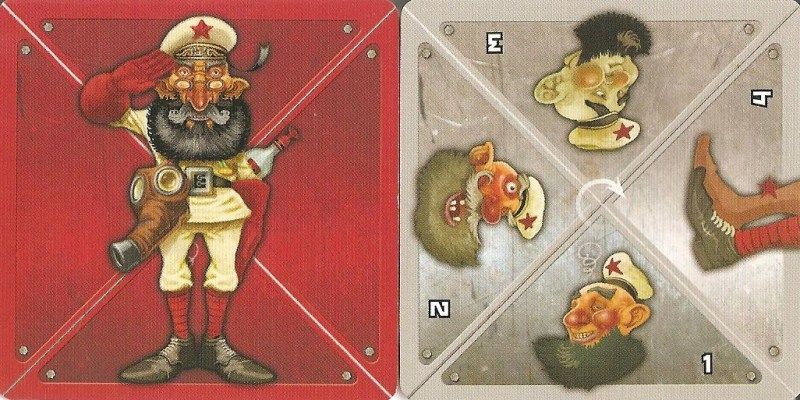 | |
| The intoxication level to the right. |
 |
| Beware the Kraken! |
The mechanic wrinkle is time track management. In short - it is confusing and fiddly. Your place on the track is marked with a corresponding colored marker. For every movement and action that takes time, you move a white "ghost" marker ahead the necessary number of minutes in front of you. Once your entire turn is complete, you move your marker forward one space at a time, drawing and resolving event cards at intermittent points along the track as indicated, until reaching the ghost marker. Then the next turn falls to the player furthest back in time, which could possibly be you again. Then there is the added element of "timed destruction events." If one of these cards are drawn, you place a token 10 minutes ahead of the point on the track at which it was drawn. If all gnomes pass this point before fixing the problem, the event destroys the ship and the game is immediately over. This entire element is confusing for kids and difficult to learn. Not that it could have been designed any differently - so it takes some getting used to. And not just for kids, either. I'm still not confident we are playing it 100% correct with all the various details to consider when managing the time track. The rulebook is not overly helpful, either, because it is poorly organized.
 |
| Tools of the trade. |
In the end, I give Red November an 8 on the Board Game Geek scale (Very good game. I like to play. Probably I'll suggest it and will never turn down a game.). The cooperative element and the over-the-top theme combine to create a funny and engaging experience that is on a different level than standard, competitive strategy games. The chaos and luck create a good tension that even kids under the recommended age rating should be able to navigate and enjoy trying to manage.
October 18, 2011
Kids View: Dust

What is the Game About?
You try to earn points by taking territory, capturing power sources (they look like targets), and building up an army. You can build tanks, mechs, fighters, bombers and subs. You also have to protect your capital and your power sources so that you don't lose points and so you can build things. You also cannot build things without your power sources. You use special dice in battles. The game also has cards. They are used to give you a certain amount of actions, to tell you what turn order you go in, and give you a special action for that turn. My favorite special card is Sigrid who lets you re-roll all of the misses in one battle roll. The first player to 30 points wins the game.
What do I Like?
It is not that complicated and I like the strategy because you have to concentrate on the power sources and on capitals. You don't have to worry as much about the whole world. The mech figures are really cool. The cards are easy to follow because they don't have words and they give you lots of choices.
What do I Dislike?
It is hard to play on the floor because the board is like a puzzle and doesn't fit together very well. I do not like the Mech Dropper card when some one else has it because it lets them attack with too many mechs and take you out really easy.
October 17, 2011
Gaming Report: Kingsburg, Red November
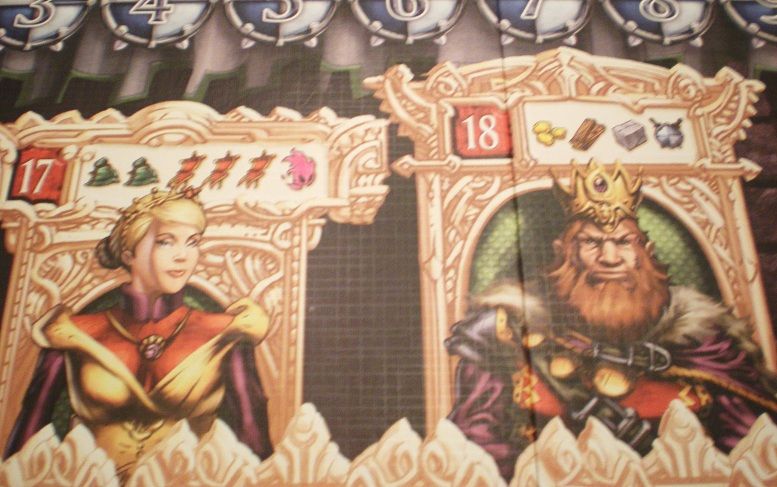
As usual, we had to squeeze some gaming in around a full schedule. The next kid in line wanted Kingsburg. And then the kid choosing after that went with the same selection! I think that’s a pretty good endorsement for a game’s child friendliness. You can read my latest review, if you did not see it already, but this is a very nice introductory Euro game. Very attractive, good range of choices that do not overwhelm you, and with dice! Once again, it is clear that you cannot concentrate on military alone. Our first game was only three-player, with Cory edging out the win on a nice balance of military and religious buildings. Our second game is not complete (due to unforeseen circumstances), but I’m currently trying out a “diplomatic” strategy with the bottom row towards the Embassy to generate a victory point after every season.
Then with visits for the foster kids on Saturday, Cory and I boarded the Red November. He really likes this title. He now asks for it more than Mag Blast, even. We scrambled like chickens with our heads cut-off until a missile malfunction in the 95th minute turned out our boat in to glass – or would have if we weren’t underwater. This game is always tense and right up to the final minutes. We actually had the Kraken threat this game, but were able to kill it before eating us. However, with only two gnomes left to deactivate the missiles, that entire half of the sub was on fire with a blocked hatch in the way!
October 15, 2011
Board Game Review: Kingsburg
Kingsburg (Fantasy Flight/Andrea Chiarvesio & Luca Iennaco, 2007)
2-5 players / 10 + / 90-120 minutes
It was a prosperous year for the land. The King’s magnanimous advisors provided me plenty of bounty for just a bit of flattery in return. I developed my province, strengthening both prestige and military. But Winter was setting in and soon the evil hordes that live beyond these realms would descend like a plague of locusts to devour all they could.
“My lord,” reported a courier. “The enemy approaches and we are outmatched!”
“Well,” I scoffed, asking, “and what of help from the King?”
A look of fear swept across his brow. “He’s only sent one soldier, still not enough to man the defenses. We’ll be crushed!”
“Arrrgh, just like him to sit fat and happy while the enemy ravages the outlying lands.” Then adding dryly, “Must be good to be the King.”
What You Get:
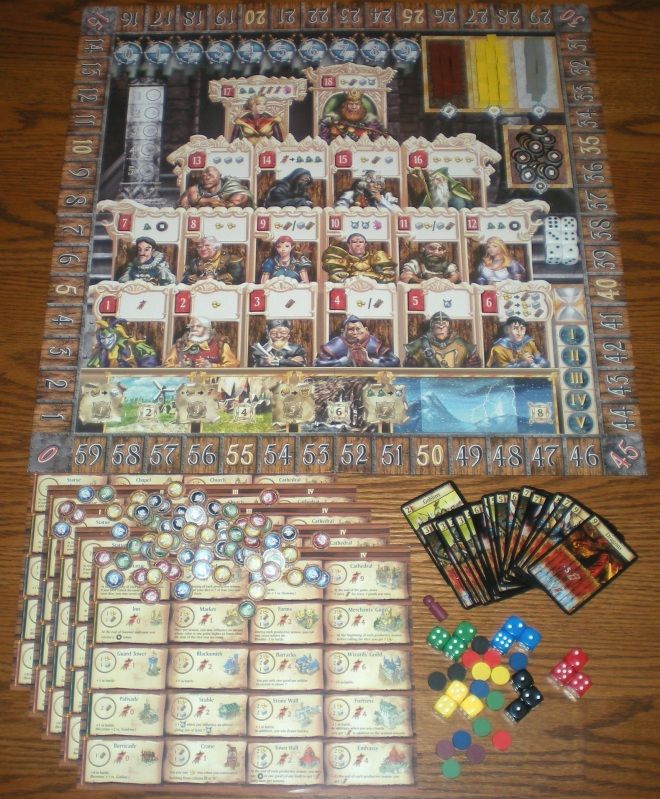
A quality, good-looking product. The board keeps track of everything except your personal buildings. The advisor boxes are big with nice artwork and have icons that clearly identify which resource(s) they make available. Several tracks surround the advisors to mark turn order, military strength, current year, and current season with a larger scoring track running around the edge of the board. Wooden tokens are used on the various tracks and wooden cubes in yellow, silver, and brown denote gold, stone, and wood. There is a small wooden pawn serving as a King’s envoy. Each player has their own individual building mat and a pile of cardboard chits to mark which structures they’ve completed. Then last, but certainly not least, the game supplies 21 dice in six different colors – kind of like a gamer in a candy store!
The Quick Rundown:
 |
| The components |
 |
| Dice Placement |
E for Everyone:
 |
| Mr. and Mrs. Your Highness. |
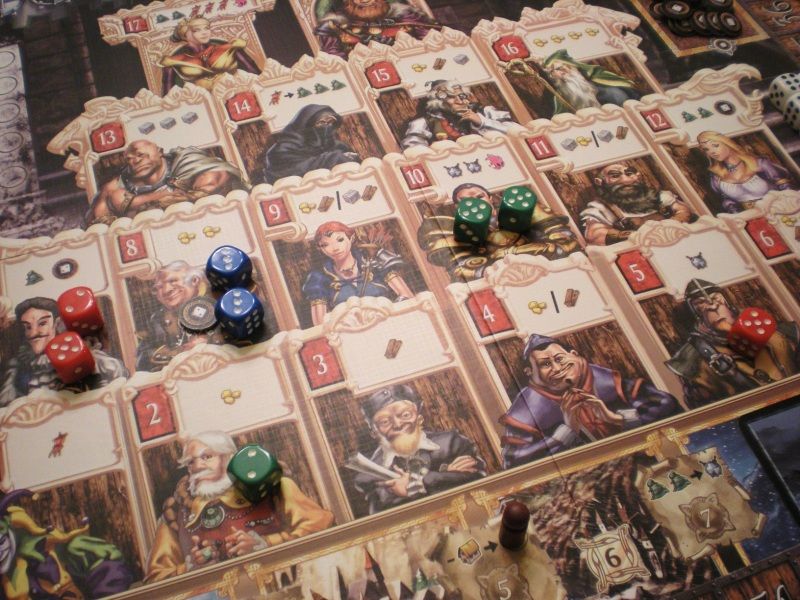
This is a really slick design. The rules are easy to understand, but you still don’t really appreciate the beautiful simplicity until getting into game play. Once you begin, it runs so smoothly with almost no downtime that, by the end, you don’t realize that an hour and a half has gone by. The dice placement mechanic is extremely intuitive. Players plan their strategies pretty much simultaneously, which reduces (but does not always eliminate) analysis paralysis. And after all dice are allocated, each turn is structured in steps to quickly resolve actions until the beginning of next season.
The random element provided by the dice is not overpowering. It certainly will influence how and when you implement your strategy, but it rarely derails it. A couple of elements still let you retain a lot of control in the game. First, although better rolls will net you better swag, there are still a variety of advisors that offer similar benefits, so you can aim for resources with different dice values. Also, there are a few building improvements and advisor benefits that allow you to manipulate your dice or even re-roll a poor result. To further mitigate bad luck, there are a couple of places each year that provide aid to the player performing the worst. And as a balance, there is also one point that provides a bonus to the player performing the best. This is a brilliant design that tosses in a bit of the unknown (just like real life), yet still favors strategic development and player control.
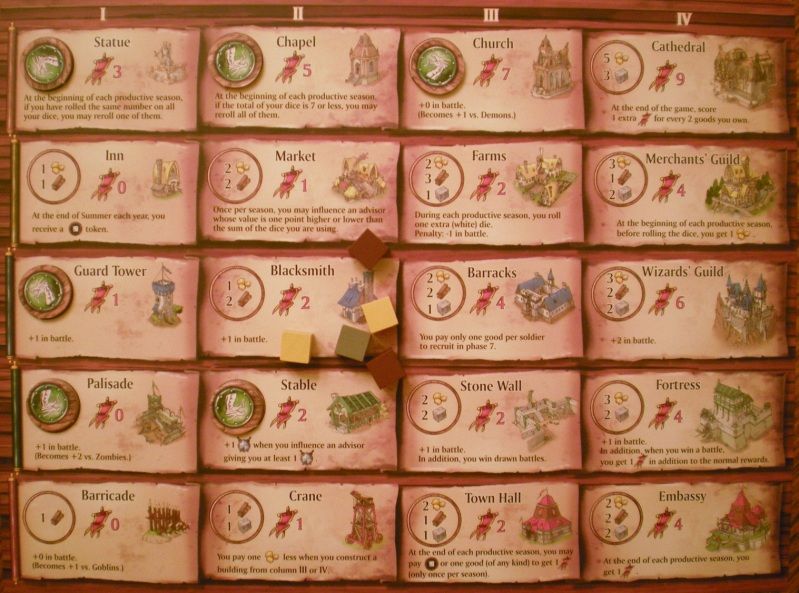
There is also a nice balance of choices in strategic development without being overwhelming. The planning lies in which buildings you choose to construct. They are all arranged on your individual mat in five rows of four buildings each. You can build in any row you wish, but only from left to right – so you cannot purchase a better building until constructing its predecessor. Each row emphasizes different benefits, so you can strongly develop one area, but only at the expense of ignoring other potential needs. But if you try to balance it out too evenly, then you’ll find yourself falling behind in points. It may not necessarily be a heavy brain-burner for experienced Euro gamers, but it is still a rich enough experience to enjoy while at the same time it provides great depth for newcomers without engulfing them. For children, this complexity level is really ideal for leaning how to make meaningful decisions and how that affects long-term strategy.
The game creates just enough tension, as well, since you don’t have enough turns to build everything you’d really like. In addition to this time constraint, you’re always on the edge of your seat when rolling the dice, hoping for that optimal combination to land the advisor you need. Even if you roll the numbers you were wanting, then you have to sit around hoping that no one else steals that advisor before you. Turn order each season is determined by total dice values, with the player rolling highest having to go last. If the values are wildly skewed, then competition over particular advisors will not be as robust. But if the values are all close (as is often the case), you may wish you had rolled even one less just to go first! In any event, the turn order and placement mechanic is generally well-balanced but still provides opportunity to “steal” advisors for an interesting, if not too terribly spiteful, “take-that” element.
 |
| The development tracks. |
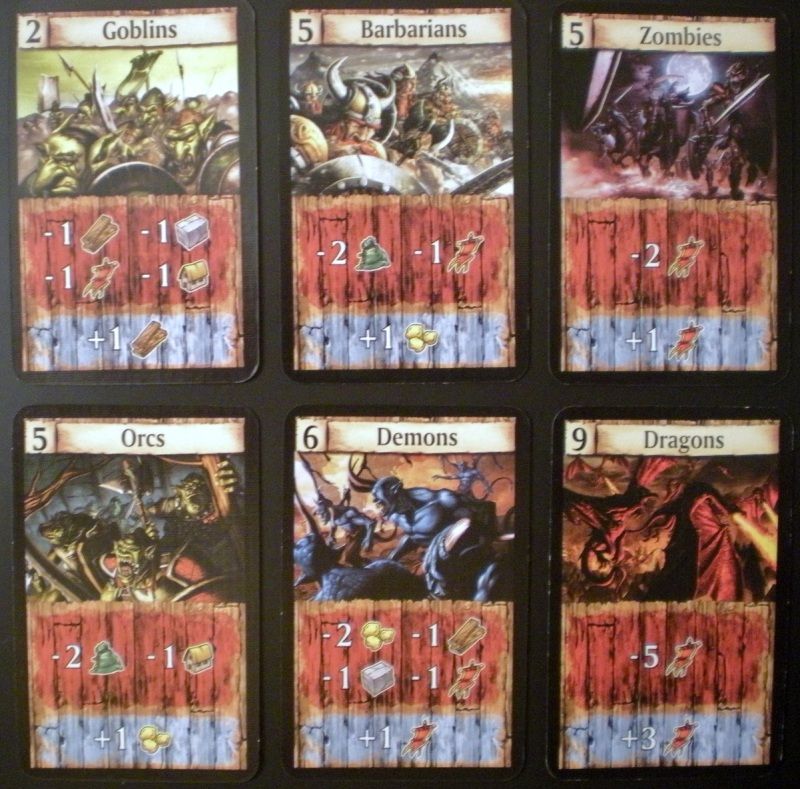
The game’s main dodgy element is the end-of-year invasion. At first, it doesn’t seem like much of an issue because you are aware of the enemy’s possible strength before the attack (it increases progressively each succeeding year). So you can plan accordingly and make sure that you have enough soldiers plus defensive bonuses to meet or exceed the enemy’s numbers. Focusing only on your military, however, will likely mean less development in other others. In that case, there is an alternative. Just before each attack, the King will send soldiers to help everyone defend hearth and home. The kicker is that that assistance is represented by one die roll. If you were banking on a lot of help and the roll is a ‘1,’ then you’re just up the creek without a paddle. Actually, it’s probably worse than that analogy, because the consequences of defeat (loss of points, resources, and/or buildings) are pretty severe for a game with only 15 opportunities to collect and build. My kids and I kind of luck this push-your-luck component, except they never let me roll the King’s reinforcement die because they say I stink at it.
 |
| The bad guys! |
I have read that the expansion, To Forge a Realm, fixes both the wonky invasion element and the replayability issue. However, it is out of print, out of stock at every online retailer (big and small) I can find, and so next to impossible to get. And my collection is not large enough to take advantage of trading opportunities, yet.
Okay, I’ll Shut-Up Now:
In the end, I personally rate this game a 7 on the Board Game Geek scale (Good game. Usually willing to play). It may not sustain serious hobby gamers over the long term (without the expansion), but it is a crisp and smart design that keeps game play flowing smoothly, with just the right amount of tension and interaction. The result is an experience that provides a pleasant introduction to the hobby and gives kids the opportunity to learn the basics of strategic planning.
October 12, 2011
Gaming With Kids: Appropriate Theme
Despite my admittedly conservative views, I don't pretend I live in a bubble or think I have my head stuck in the sand. I cannot filter everything my kids see or hear. I cannot keep them by my side 24/7, nor would I think that even healthy! But obviously as a parent, I concern myself with what they watch and listen to. Prime time television is just not family oriented with shows like Desperate Housewives, Modern Family, Two and a Half Men, and the nauseating litany of cop, lawyer, and doctor dramas which all try to "push the envelope" and one-up each other with steamy or gritty content. In video gaming, we pass on the completely overt and pointlessly violent titles. In music we avoid the Top 40 Pop radio stations because half the songs are about drinking, partying, sex, and objectifying women.
To bring it back on-topic, I have lately started thinking in terms of appropriate themes in gaming as I read more and more about the hobby. Several months before I started this blog, there was an excellent podcast at Dice Hate Me that addressed some of these issues. That discussion focused more on how the inclusion of mature artwork (nudity, sensual imagery, or drugs) should impact a game's recommended age rating.
Artwork can certainly be a concern, especially when some more questionable imagery is included in an otherwise kid-appropriate game. As an example on the Dice Hate Me podcast, the original age recommendation for the game Olympos is 10+ which is fine regarding mechanics, rules complexity, and theme. However, the artwork is not appropriate for a 10 year old. American distributors are recommending 13+ and perhaps some high school boys might handle it maturely; but even in that I'm not really confident. Nevertheless, what is most disappointing is that the game doesn't even need such artwork. It would play just as well with imagery appropriate to all ages. I say this realizing that there is probably a European-American viewpoint disconnect somewhere in all this.
Then there are some games generally, all-around appropriate for children, but yet include only one piece of questionable content, again usually unnecessary and unimportant to game play. We own and enjoy Dust, but the rulebook stays in the box as much as possible. I don't make a big deal about it, but there is no need drawing attention to an illustration that merely exists to prominently display some woman's "features." At least to my 8-year old boys. Many other titles venture into this same area, usually with a risque illustration, such as 7 Wonders, Sylla, Castle, and many more. These are fairly easily dealt with for the most part.
 |
| Tanto Cuore/Courtesy of Raiko Puust (binraix on BGG) |
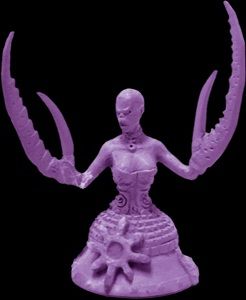
Regarding war games, I see no issue with children playing. They are not gratuitous and can actually be educational if historically themed. Even if existing in a fantasy or alternate world, it will usually be abstracted enough to be suitable. However, I'm not saying violence is never an issue. On one side, if the theme is over-the-top and lighthearted, it can be Python-esque. You can read my review on why I believe Lifeboat is suitable for children despite the fact that you're trying to make your opponents into fish food. There are other games in the same vein.
 |
| Chaos Demonette. |
 |
| Nightfall card/Alderac Entertainment Group |
I understand not all will agree with these views. As I mentioned, there is a dynamic of European vs. American cultural norms on top of just personal opinion regarding the issue. Realizing that, I don't feel as if I'm and ostrich with my head in the sand. Assuredly, my Christian faith forms much of my sentiments on raising children. So I will continue to filter the board games we purchase and play. Call me old-fashioned, but the less they are desensitized by such content now, the better served they will be as adolescents and young adults and beyond.
Subscribe to:
Posts (Atom)