The weekend was a little easier, schedule-wise, but it was also absolutely beautiful, weather-wise. So we spent some good time outside, and managed a little gaming, too. Kids were in-and-out, too, with visits and spending the night at other places - so no 5 player sessions. The main game was (is) a 4 player game of Attack! This light, dudes-on-a-map, strategy dice-fest still takes us a minimum 3 hours, so it's one that gets played over several days as we have time. It is still set-up as of this posting with hopes to wrap up tonight.
For a little while, it was just me and my son, so we got in a couple 2 player games of Mag Blast and Red November. He quickly destroyed me in Mag Blast even though his race was weak. We blasted away at each other with a fury, destroying many fleet ships until he played the dreaded "blast-direct hit-catastrophic hit" combo on my command ship - game over! Then we spent a frenzied hour aboard the Red November. Or actually I should say 56 minutes. That's right we were four minutes from rescue when our boat was crushed in the deep depths of the Baltic Sea. Crazy thing was that I managed to get in the engine room with an engine manual, but it was on fire, which means I had to extinguish that first! Didn't get that last turn. We got our revenge on, well...um...fate, I suppose...in a 3 player game later in the weekend. Perhaps it was an anomaly, but that game was not as frantic? Either we were extremely lucky or the 3 player version is not as optimal. Of course, there are a couple of variants to add that could ratchet up the destruction upon the next 3 player voyage which we set sail.
October 03, 2011


September 30, 2011
Card Game Review: Lifeboat
Lifeboat (Gorilla Games/Jeff Siadek, 2010[3rd Ed.])
4-6 players / 12+ / 45-60 minutes
The First Mate was getting a bit smug for his own good. Throwing his weight around, literally, he began to rule the roost, forcing us to change seats with him and taking all of our stuff. The biggest of the survivors, with biceps like tires and a chest like a barrel, he bullied his way from one end of the small, floundering boat to the other. "I'll be taking that parasol, there, Sir Stephen," he smiled wryly.
"Oh, not this time," the normally timid aristocrat answered.
"Look, here, you little pipsqueak, hand it over before I pound you and throw you in for fish food!"
"How 'bout THIS instead?" And whipping out a flare gun from inside his coat and thrusting into the Mate's face, Sir Stephen fired off a spectacular burst of light and fire that sizzled and cracked through the air.
Grasping in pain, the Mate yelled out, "Aaaah, my eeeeeeeeeeeeeeeeeeeeyes!"
What You Get:
A total of 96 cards, 3 small wooden birds, and about 20 plastic wound chips (appropriately translucent red). The cards are not linen-textured, but they are of a very durable stock. My kids have not yet managed to scuff or crease them even in the slightest, despite our numerous plays. Believe me, that alone is a testimony in itself! They are humorously illustrated and fit perfectly with the zany theme. The wooden birds are a superfluous, but very fine touch. The tokens make keeping track of wounds quick and easy, though we've had many a particularly nasty games in which we could have used more than those provided. And in a stroke of cost-saving genius (that this budget-bearing consumer appreciates) the rules are printed on a sheet of paper.
Quick Rundown:
The premise of Lifeboat is that you represent one of 4-6 survivors of a sunken, Titanic-like ocean liner. Goal #1 is to just survive until land is sited. That simple matter, however, will be complicated by everyone's ulterior motives. Goal #2 is to acquire as many provisions as you can to earn extra points. Goal #3 is to help your secret love survive with you. Goal #4 is to make sure your hated rival doesn't. Everyone begins the game with a random character in assigned seating, a random secret love, and a random secret enemy. On your turn, you may either row the boat, use a provision card, attempt to mug some one else for one of their provisions, attempt to switch places with some one in the boat, or pass. Your place in the boat is important. If first in order, then you get the first selection of provisions passed around at the beginning of each turn. If last, you get to pick the navigation card played at the end of each turn. Provisions give you good things like water, med kits, points, and weapons. The navigation cards usually spell doom for one or more of the characters. If you attempt to mug or switch seats with some one and they don't play along nicely, a fight ensues. While each character has a set strength value, others are allowed to join in the fisticuffs on one side or the other. Plus you can play weapons to add to your strength. But so can your target, and so can your allies, and so can your target's allies. As you can imagine, it's not uncommon for a boat-wide brawl to ensue somewhat on the scale of mini-Waterloo.
E for Everyone:
Now, as usual, keep in mind this 'E for Everyone' bit does not mean I think every gamer will enjoy this little gem. It means that I think kids will easily grasp the concept and mechanics of it while adults can genuinely enjoy playing it with them, as well as in their own adult gaming groups. This is by far the most spiteful game in our collection and, indeed, one of the most spiteful games I've ever read of. More on that in a minute. First, why do I give such a confrontational game the 'E' rating? Oh, let me count the ways.
The basic rules are straight-forward. Once you understand the five simple actions you may choose from each turn, the rest of play flows smoothly. Any other rules-breaking mechanic is clearly explained by card text. The end-of-round navigation phase is also quick and easy. The last player in turn order will look at the few available navigation cards and choose one. It gives information on how much closer you're getting to land, who gets washed overboard into the sea, and who gets thirsty. Proximity to land is represented by the bird tokens (you need four of them to end the game). Wounds are represented by the plastic chips if you lose a fight, are thrown overboard, or get thirsty (some provisions prevent wounds from thirst or getting tossed over).
Downtime is minimal, also because of the nature of the action phase. Rowing, passing, or playing a provision card is fast. Fights can take a tad longer because of the diplomatic meta game in deciding who will fight for who. It's obviously natural to want to help your secret love and hurt your secret enemy, but if you're too obvious, you could create more problems for yourself in the long run. Or it's possible you really couldn't lend much aid in a given fracas, whether you wanted to or not, so you just kind of quietly sit tight. Engaged or not, you will still be very interested in the scuffle's outcome, so downtime is almost irrelevant. Besides that, they're hilarious. You certainly don't want to miss some one catching a grappling hook in the eye. I mean, I don't care who you are, that's funny.
The aforementioned diplomatic meta game works very well with what I call the reverse secret identity mechanic. With loves and enemies hidden, the psychological game of figuring out each others' ulterior motives is balanced with the goals in regards to your own love and enemy. This is a process that my kids can grasp, because it gives them a framework with which to think through. In a twisted sort of way, the game would be even more chaotic without it. It also takes the personal bite out of the spite since, by and large, your alliances are motivated by what the game deals you. However, we also often have shifting allegiances by going mercenary to the highest bidder. Indeed if you're one of the weaker characters and happen to love yourself (thus no one watching your back), that's one of the few options you have. You may survive by avoiding every fight and you'll get double points for doing so, but you'll be danged lucky if you arrive at shore with anything more than the shirt on your back.
Now just because children can grasp the game, doesn't necessarily mean they'll be able to handle the spite - which also holds true for adults, I'd imagine. Since gameplay is smooth, the theme is humorous, and the secret love/enemy mechanic dampens the spite, we generally have amicable games. Whenever we have an issue it is generally a result of how the role cards are randomly assigned. If you are your own secret love, then it can be rough going. If you love and hate yourself, then you're a psychopath and only get bonus points for everyone dying - which is difficult to achieve. And if you love or hate the same person, you're not always sure how to proceed - though you get more points for them living than dying.
So concept-wise, this game will not be to everyone's liking. Not only is there direct confrontation, but it is brutal and often back-stabbing. There is player elimination. There is luck in drawing the provision and navigation cards that will be helpful to you at the right times (though trading of provisions is allowed). It can go a little long if there isn't much fighting and you're not drawing the navigation cards that get you closer to land. And some may object to the overt violence. That is one thing I consider before buying a game for me and my kids - but here it is so over-the-top that it's almost Python-esque. I grew up on them and am no worse for the wear...or so I think.
Okay, I'll Shut Up Now:
In the end, I give Lifeboat an 8 on the Geek scale (Very good game. I like to play. Probably I'll suggest it and will never turn down a game.). For a chaotic game, it generally plays smoothly and in under an hour. If your kids can play Citadels, then they will be able to grasp Lifeboat's mechanics and gameplay. The 12+ age recommendation is probably in anticipation of the hurt feelings that the spite factor could create. But my kids often request this unique title and the laughing always outnumbers the finger-pointing.
4-6 players / 12+ / 45-60 minutes
The First Mate was getting a bit smug for his own good. Throwing his weight around, literally, he began to rule the roost, forcing us to change seats with him and taking all of our stuff. The biggest of the survivors, with biceps like tires and a chest like a barrel, he bullied his way from one end of the small, floundering boat to the other. "I'll be taking that parasol, there, Sir Stephen," he smiled wryly.
"Oh, not this time," the normally timid aristocrat answered.
"Look, here, you little pipsqueak, hand it over before I pound you and throw you in for fish food!"
"How 'bout THIS instead?" And whipping out a flare gun from inside his coat and thrusting into the Mate's face, Sir Stephen fired off a spectacular burst of light and fire that sizzled and cracked through the air.
Grasping in pain, the Mate yelled out, "Aaaah, my eeeeeeeeeeeeeeeeeeeeyes!"
What You Get:
A total of 96 cards, 3 small wooden birds, and about 20 plastic wound chips (appropriately translucent red). The cards are not linen-textured, but they are of a very durable stock. My kids have not yet managed to scuff or crease them even in the slightest, despite our numerous plays. Believe me, that alone is a testimony in itself! They are humorously illustrated and fit perfectly with the zany theme. The wooden birds are a superfluous, but very fine touch. The tokens make keeping track of wounds quick and easy, though we've had many a particularly nasty games in which we could have used more than those provided. And in a stroke of cost-saving genius (that this budget-bearing consumer appreciates) the rules are printed on a sheet of paper.
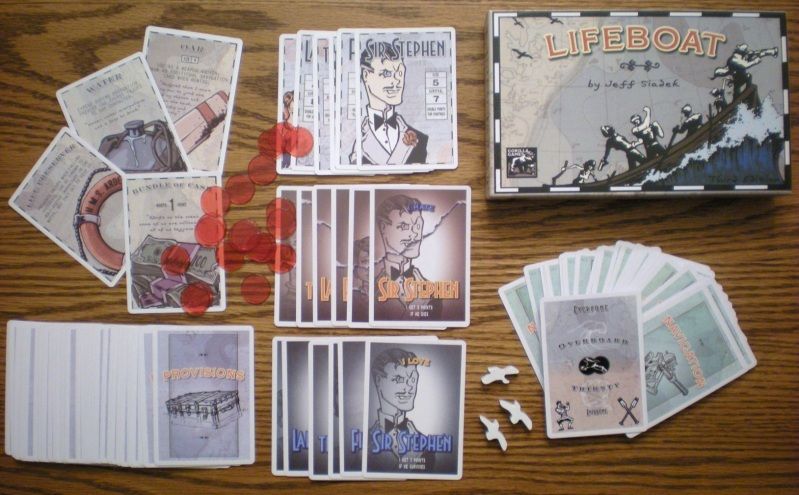 |
| The components. |
The premise of Lifeboat is that you represent one of 4-6 survivors of a sunken, Titanic-like ocean liner. Goal #1 is to just survive until land is sited. That simple matter, however, will be complicated by everyone's ulterior motives. Goal #2 is to acquire as many provisions as you can to earn extra points. Goal #3 is to help your secret love survive with you. Goal #4 is to make sure your hated rival doesn't. Everyone begins the game with a random character in assigned seating, a random secret love, and a random secret enemy. On your turn, you may either row the boat, use a provision card, attempt to mug some one else for one of their provisions, attempt to switch places with some one in the boat, or pass. Your place in the boat is important. If first in order, then you get the first selection of provisions passed around at the beginning of each turn. If last, you get to pick the navigation card played at the end of each turn. Provisions give you good things like water, med kits, points, and weapons. The navigation cards usually spell doom for one or more of the characters. If you attempt to mug or switch seats with some one and they don't play along nicely, a fight ensues. While each character has a set strength value, others are allowed to join in the fisticuffs on one side or the other. Plus you can play weapons to add to your strength. But so can your target, and so can your allies, and so can your target's allies. As you can imagine, it's not uncommon for a boat-wide brawl to ensue somewhat on the scale of mini-Waterloo.
E for Everyone:
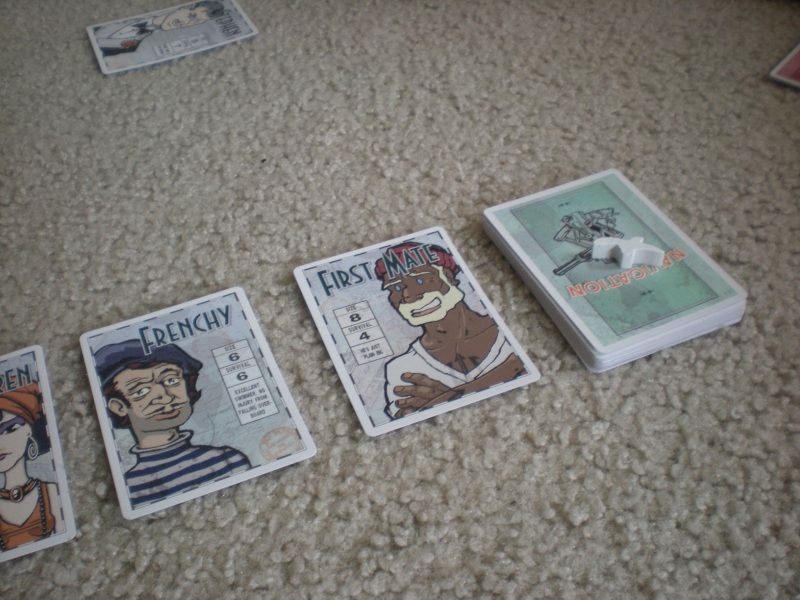 |
| The bow of the boat with nav cards. |
The basic rules are straight-forward. Once you understand the five simple actions you may choose from each turn, the rest of play flows smoothly. Any other rules-breaking mechanic is clearly explained by card text. The end-of-round navigation phase is also quick and easy. The last player in turn order will look at the few available navigation cards and choose one. It gives information on how much closer you're getting to land, who gets washed overboard into the sea, and who gets thirsty. Proximity to land is represented by the bird tokens (you need four of them to end the game). Wounds are represented by the plastic chips if you lose a fight, are thrown overboard, or get thirsty (some provisions prevent wounds from thirst or getting tossed over).
Downtime is minimal, also because of the nature of the action phase. Rowing, passing, or playing a provision card is fast. Fights can take a tad longer because of the diplomatic meta game in deciding who will fight for who. It's obviously natural to want to help your secret love and hurt your secret enemy, but if you're too obvious, you could create more problems for yourself in the long run. Or it's possible you really couldn't lend much aid in a given fracas, whether you wanted to or not, so you just kind of quietly sit tight. Engaged or not, you will still be very interested in the scuffle's outcome, so downtime is almost irrelevant. Besides that, they're hilarious. You certainly don't want to miss some one catching a grappling hook in the eye. I mean, I don't care who you are, that's funny.
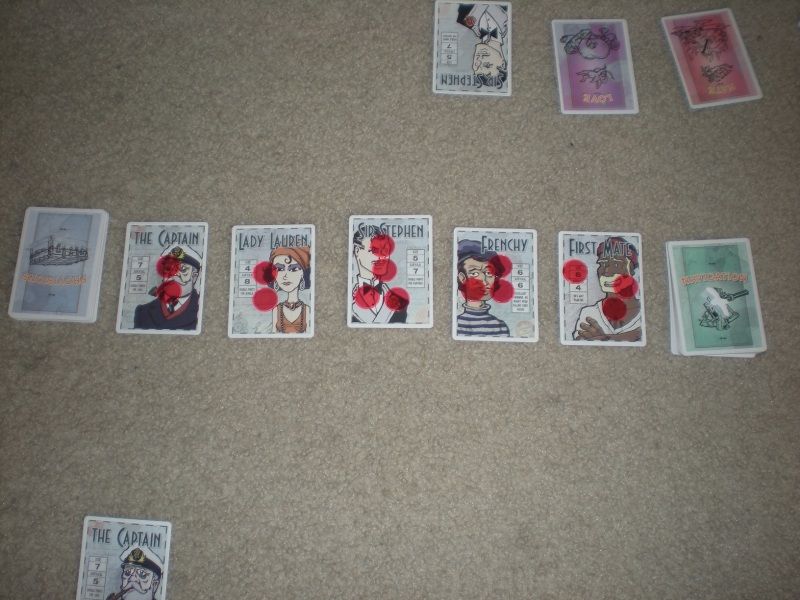 |
| Its been a brutal voyage! |
Now just because children can grasp the game, doesn't necessarily mean they'll be able to handle the spite - which also holds true for adults, I'd imagine. Since gameplay is smooth, the theme is humorous, and the secret love/enemy mechanic dampens the spite, we generally have amicable games. Whenever we have an issue it is generally a result of how the role cards are randomly assigned. If you are your own secret love, then it can be rough going. If you love and hate yourself, then you're a psychopath and only get bonus points for everyone dying - which is difficult to achieve. And if you love or hate the same person, you're not always sure how to proceed - though you get more points for them living than dying.
So concept-wise, this game will not be to everyone's liking. Not only is there direct confrontation, but it is brutal and often back-stabbing. There is player elimination. There is luck in drawing the provision and navigation cards that will be helpful to you at the right times (though trading of provisions is allowed). It can go a little long if there isn't much fighting and you're not drawing the navigation cards that get you closer to land. And some may object to the overt violence. That is one thing I consider before buying a game for me and my kids - but here it is so over-the-top that it's almost Python-esque. I grew up on them and am no worse for the wear...or so I think.
Okay, I'll Shut Up Now:
In the end, I give Lifeboat an 8 on the Geek scale (Very good game. I like to play. Probably I'll suggest it and will never turn down a game.). For a chaotic game, it generally plays smoothly and in under an hour. If your kids can play Citadels, then they will be able to grasp Lifeboat's mechanics and gameplay. The 12+ age recommendation is probably in anticipation of the hurt feelings that the spite factor could create. But my kids often request this unique title and the laughing always outnumbers the finger-pointing.
September 29, 2011
Gaming with Kids: Replayability

Have you ever played "Horsey" with a toddler? You know, where you put the kid on your knees and the baby horse goes nimble-nimble, the mommy horse goes trot-trot, and the daddy horse goes gallopy-gallopy? Oddly enough, it's a lot of fun! I guess because we adults find joy and take pride in the ability to make a little kid smile, giggle, and out-right belly laugh. We can momentarily forget the responsibilities of grown-up life in the warmth of an innocent child. Of course the kid likes it, too. So she says, "Again, again!" We comply. Laughs ensue. She beams, "Again, again!" Another nimble, trot, gallop. Whee! Then she giddily pleas, "Again, again!" And so on it goes. Until after about a dozen rides around the track, you're ready to be taken out to pasture and shot for glue.
Suffice it to say, kids like continuity. Which is the antithesis to a major consideration in game design: replayability. Yes, it is not even a real word. But it is a central concept that influences designers in their board game creations, as well as consumers in their board game purchases. For hobby gamers, replayability is the idea that a game offers something new and fresh in each play. It possesses some mechanic or component that changes things up, even if only slightly, each session. Games may achieve this in a few ways. It could have a modular board like Settlers of Catan where the set-up is different each time. It could provide the infamous "multiple paths to victory" like Caylus where you can explore different strategies to win. It might include asymmetry based on varying powers like Cosmic Encounter where each race has different abilities or bonuses. On top of any of those, it can even come out with an expansion that adds new elements, components, rules, and/or scenarios such as Kingsburg: To Forge a Realm (some titles get a little excessive in this department).
For hobby gamers who spend good money on their games, it is not unreasonable that they expect to be able to get many plays from that purchase. A game that only offers one set of choices, or one path to victory, or limits your options in other ways can quickly grow stale and will have limited appeal. That can be compounded by the game's length. Shorter board games and many card games may often overcome the stigma of limited breadth because of their brevity. However, most serious strategy gamers are looking for replayability. Generally speaking, we like options, change, and to try new things. We don't like the game playing us.
This is just the reverse in gaming with kids. Certainly as they grow older and delve more into the hobby, that can, and often does, change. But for a good deal of a child's gaming life, they'll feel more comfortable with the familiar. They learn by repetition and prosper in continuity. The more options you throw at them, the more insecure they'll feel in the confusion. As I mentioned in my blog entry on kids and strategy, children will generally operate under a "one thing at a time" mentality, becoming frustrated when the unforeseen spoils their plans. Now this is not to claim you will cause irreparable emotional damage by thrusting certain titles in front of their faces. But again, the point here is to acclimate kids to the hobby - and games with repetition can serve an important role in that process.
One question my wife and I are constantly asked is how we manage to care for up to eight kids at a time and see so many come in and out of the house. Well, first, by the sheer grace of God! And then, while not claiming it is easy or stress-free, we manage with a routine. This is even exponentially more important with foster children who invariably have never had anything remotely close to routine in their lives. Schedules, structure, and rules that apply to everyone maintain a little order...at least in managing the chaos. This concept influences our gaming, too. We have a set order in selecting games - each child gets his/her turn. We have a routine for determining who goes first (when the game does not specify). A routine for picking colors/sides. The kids even like to sit in the same order around the floor or table. And we usually have set times in which to play games, determined by - you guessed it - our schedule!
Likewise, my kids generally approach gaming from the opposite spectrum of replayability. This isn't to say they'll never try new things, but overall they stick with what they know. Even in games that offer variability, they'll continue to play certain ways. They like to pick the same action cards in Dominion even though there are two dozen to choose from. Many times they'll select the same character in Citadels over and over whether it benefits them in a particular round or not. They often employ the same strategies in a war game because, well, I'm not sure why sometimes! And in any case, whenever possible, there is always continuity in that they like to gang up on dad!
So keep that in mind when sharing the joys of hobby gaming with your kids. Take it in stride and humor them. You may be in for some repetition, but there's usually a reason they're sticking with what they know. And as they present themselves, find opportunities to suggest new things or propose other options on old favorites. In the end, it'll be worth all the nimbling, trotting, and galloping.
September 26, 2011
Gaming Report: Lifeboat, Cribbage, and Rummy
Once again it was a packed and busy weekend with family visiting from out-of-town because of my youngest daughter's 4th birthday. The kids and I got in a couple games of Lifeboat, including one in which we introduced the game to my 12-year old nephew - a new hobby gamer, maybe?! I think my next review will be on this cutthroat, little gem and I'll have the kids weigh in on it, too, next time we play. This game can cause some "issues" because it involves things like shooting the person next to you in the face with a flare gun. Some feelings will get hurt, but it's manageable. I won the first game as the Captain with Sir Stephen as my ally (he loved me - which may sound disturbing if you're not familiar with the game - but its legit - trust me). I had to avoid fights with the First Mate. The second game I was Sir Stephen but unfortunately I loved myself (now, come on, admit it, you're intrigued) and so had no ally. My kids like to gang up on me when possible, and I was knocked unconscious and thrown overboard - end of game for me!
While I game with my kids the most, I do get to play with adults, sometimes! And that is generally when hanging out with family. I've been playing cribbage since my grandparents taught me in high school. My mom and I play when we're visiting one place or the other, so we got a few games of that it. It's a really enjoyable game and I recommend it for those interested in different types of card games beside ones like poker, rummy, hearts, and spades. Those are all good, too, though, and I played some rummy, as well. In fact, that is one of the few games my teen daughter likes to play, so I enjoy it for that reason alone, really. But there's only so much to the game - basic set collecting and hope you draw the right cards. But replayability isn't the goal/focus in standard card games. In fact, I think I need to write on replayability.
While I game with my kids the most, I do get to play with adults, sometimes! And that is generally when hanging out with family. I've been playing cribbage since my grandparents taught me in high school. My mom and I play when we're visiting one place or the other, so we got a few games of that it. It's a really enjoyable game and I recommend it for those interested in different types of card games beside ones like poker, rummy, hearts, and spades. Those are all good, too, though, and I played some rummy, as well. In fact, that is one of the few games my teen daughter likes to play, so I enjoy it for that reason alone, really. But there's only so much to the game - basic set collecting and hope you draw the right cards. But replayability isn't the goal/focus in standard card games. In fact, I think I need to write on replayability.
September 21, 2011
Board Game Review: Mission: Red Planet
Mission: Red Planet (Asmodee/Bruno Cathala & Bruno Faidutti, 2005)
3-5 players / 10+ / 60 minutes
Inside, I was smiling proudly. Just the previous turn, I had successfully put three astronauts on a rocket, which left only one space that didn't do the others much good. Now I was ready to place a fourth and gloriously claim a region of Mars for...um...well, the color Green! That is, if they made it there alive! Brendon is always the one who likes to blow things up, but he already played his Saboteur. I waited thoughtfully as roles were called out in order. Surely none of the others would dare? Why, they are always so peaceful. Brendon is my only pyro. Then, nervously, I called out for role #5, the Saboteur. All quiet. Would I succeed? And then...a grin...from Hope. Hope! Oh, how ironic a girl with such a name would ruin mine! She flips it over and gestures to my rocket. You little twerp!
What You Get:
The components are not particularly impressive, but they are certainly functional. The two boards are small (not a criticism) and refuse to lay flat (a criticism). The "astronauts" are tiny wooden discs, smaller than a smartie, and difficult for my fat nubs to handle. The rockets, destination markers, and scoring tokens are all on a sturdy enough cardboard - but be careful punching them out as they are not perforated well. The cards are slick and of basic stock. While I could take some flak for commenting on a vac tray, the one here is about worthless and was not designed for this game. I just tossed mine and, as a result, all the (bagged) pieces just kind of shift around inside. The artwork, however, is the exception to the average components. Produced in a steampunk style, the role cards and rocket ships are fantastically imaginative and evocative of an H. G. Wells world.

The Quick Rundown:
Mission: Red Planet is an area majority game combined with a secret role selection mechanic. Each round, you'll compete to fill up space on a rocket ship that, once filled, will launch to a particular region of Mars. Each rocket generally specifies which region it will land in and how many astronauts it can carry. When one launches, it is replaced by a new rocket on the launch pad. After three specified rounds in the game, you will score each region by awarding points based on majorities. Now, describing the game like this makes it sound like an orderly and controlled affair, worthy of a Euro game label. But I might as well say that Richard Simmons is a calm and quiet man. Each turn you'll select a role that gives you a certain ability for that round. Like the Soldier who lets you kill off other astronauts. Or a Pilot who allows to you change rocket destinations. Or the Saboteur who gives you license to blow up a rocket - with astronauts on it! You can even go all Lucy Liu on some one with the Femme Fatale and switch astronauts anywhere on the boards. Then Bonus and Discovery cards give you "secret missions" to complete by the end of the game to score extra points or just plain turn a region's end-of-game scoring on its Martian head. This all creates so much chaos that even Nietzche couldn't see order coming out of it.
Rated E for Everyone:
That chaos element will turn off a lot of gamers, but Mission: Red Planet is a hit at our house. I currently rate this game an 'E' with the caveat, "Know your family!" If they are the type to take things personally or get upset over the "take that" slap upside the head, then you may wish to play a different title. The interaction can be very much "in your face" and abrupt. However, from our experience, I think that spite factor is mitigated nicely by a few things.
First of all, gameplay is smooth and easy. It is not heavy on rules. At the beginning of each round, you'll secretly select which character you want and take your turn as each is revealed in order. Each person has the same set of role cards, so it's possible you'll select the same role as another player in any given round. Regardless, the character cards clearly define what actions you make take, how to perform them, and where. The two in-game scoring rounds are a also very simple matter. The only bit of confusion comes in scoring at the end of the game, since the Discovery and Bonus cards can change up how points are awarded.
Gameplay is also fast! The game consists of exactly 10 rounds, with scores tabulated after rounds 5, 8, and 10. This limit keeps the game consistently at 60 minutes or less. It also adds a good deal of excitement and tension since you never seem to have quite enough time to do everything you want. Individual turns are also brief. Essentially you place astronauts on a ship and then perform your character's special ability. Then it's the next person's turn. This keeps downtime to a wonderful minimum.
The theme is fun and on the lighter side. The characters generally work and their abilities make sense. Not that I'm asking for realism in a game about steam power launching rockets to Mars in the Victorian Era. Still, I'm not sure how the Femme Fatale makes sense in the scheme, nor what the ability to switch astronauts has to do with the archetype. She could have been a ninja, robber baron, or voodoo witch doctor, for all that. In any event, the unique and creative theme makes for an enjoyable hour of gameplay and helps sooth the burns of conflict.
The spite aspect I think will really make this title a "take it or leave it" extreme. You'll either take it in stride with the understanding that its a central mechanic of this game's design. Or you'll leave it because it'll cause too many fights and heartaches. However, the spite is mitigated somewhat through the limitations of role selection. Once you play a character, you cannot play that role again in future turns until you spend one turn playing the Recruiter. He allows you to collect all previously used characters so that they are available again in subsequent rounds. Therefore, you're not able to kill off opposing astronauts turn after turn after turn, ad nauseum. Also, the non-spiteful roles provide other abilities that are too beneficial to ignore. You simply can not spend the entire game going after the other players. In a two-player game you might win with that strategy, but I imagine that is the main reason this is a game for 3-5 players.
Now while the interaction isn't necessarily incessant, I don't mean to minimize it's impact. When you are attacked, it can really be rough and derail your plans. Since you have so few turns to implement any strategy, one well-timed attack can really cause irreparable damage. Also, Discovery cards can be played secretly in certain regions which change the way they are scored at the end of the game. So even if you have the majority in the region, it may not matter. The Scientist role does let you sneak a peek at a card so you can avoid or prepare for any surprises; but if a lot of them are put into play, the percentages start mounting against you. And then there are Bonus cards. Some assign you a secret mission to accomplish by the end of the game for extra points. There is some strategy in completing these missions, as long as another player doesn't derail them! Then others just randomly give you extra points without any effort exerted on your part. The balance here is that these factors affect all players equally. But that may provide little consolation to heavy strategy gamers who like to have most of the control and information at all times.
Okay, I'll Shut Up Now:
In the end, I give Mission: Red Planet an 8 on the Geek scale (Very good game. I like to play. Probably I'll suggest it and will never turn down a game.). Despite the abruptness of the interaction, I would recommend this title as a sort of "gateway" game to introduce your kids to conflict and spite. There are many hobby games, even typically peaceful Euros, that utilize some sort of "take that" mechanic in which you can attack your opponents, or otherwise mess with their plans. The sooner they learn to deal with it as a good sport, the better. This smooth, brisk, and creatively themed title provides a quick gameplay experience that just might serve well in easing them into that transition.
3-5 players / 10+ / 60 minutes
Inside, I was smiling proudly. Just the previous turn, I had successfully put three astronauts on a rocket, which left only one space that didn't do the others much good. Now I was ready to place a fourth and gloriously claim a region of Mars for...um...well, the color Green! That is, if they made it there alive! Brendon is always the one who likes to blow things up, but he already played his Saboteur. I waited thoughtfully as roles were called out in order. Surely none of the others would dare? Why, they are always so peaceful. Brendon is my only pyro. Then, nervously, I called out for role #5, the Saboteur. All quiet. Would I succeed? And then...a grin...from Hope. Hope! Oh, how ironic a girl with such a name would ruin mine! She flips it over and gestures to my rocket. You little twerp!
What You Get:
The components are not particularly impressive, but they are certainly functional. The two boards are small (not a criticism) and refuse to lay flat (a criticism). The "astronauts" are tiny wooden discs, smaller than a smartie, and difficult for my fat nubs to handle. The rockets, destination markers, and scoring tokens are all on a sturdy enough cardboard - but be careful punching them out as they are not perforated well. The cards are slick and of basic stock. While I could take some flak for commenting on a vac tray, the one here is about worthless and was not designed for this game. I just tossed mine and, as a result, all the (bagged) pieces just kind of shift around inside. The artwork, however, is the exception to the average components. Produced in a steampunk style, the role cards and rocket ships are fantastically imaginative and evocative of an H. G. Wells world.
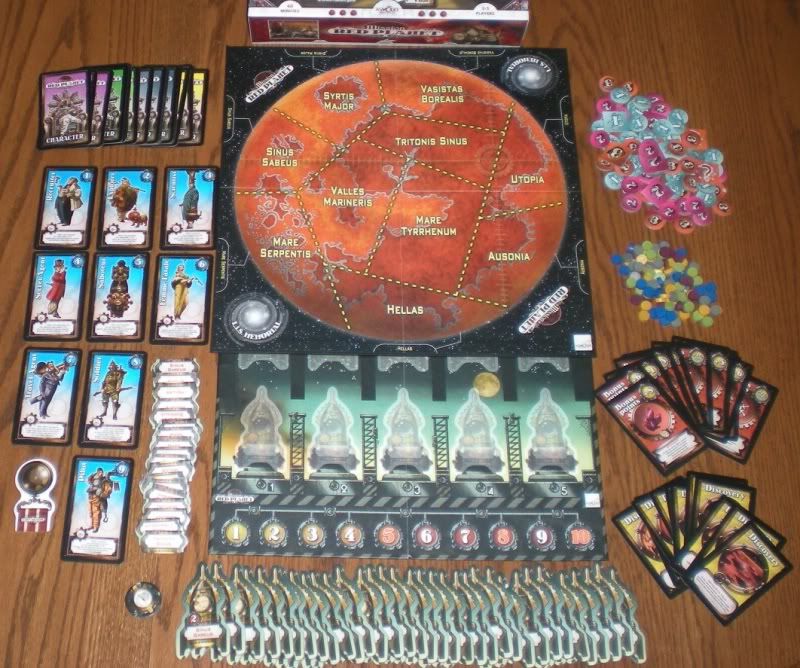
The Quick Rundown:
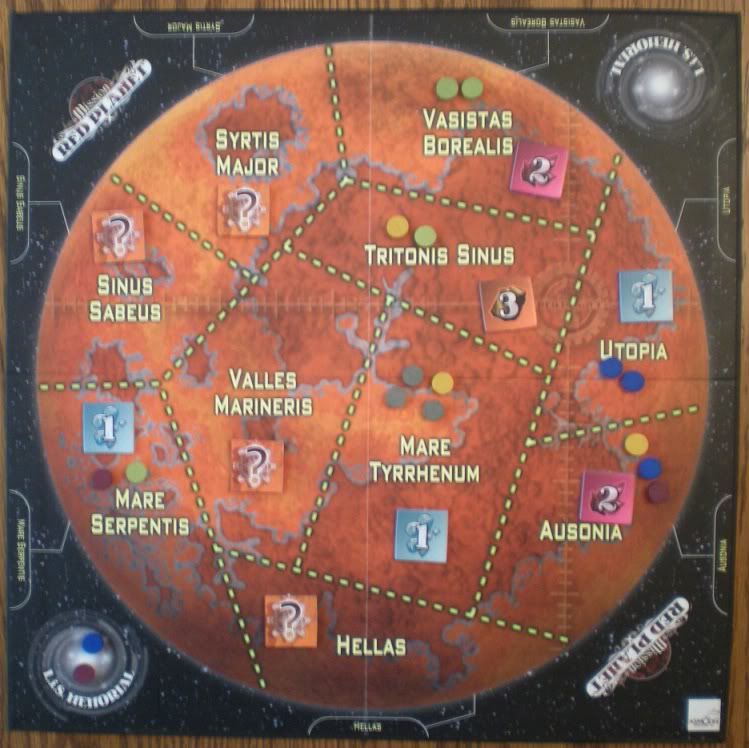 |
| Mars! With astronauts. |
Rated E for Everyone:
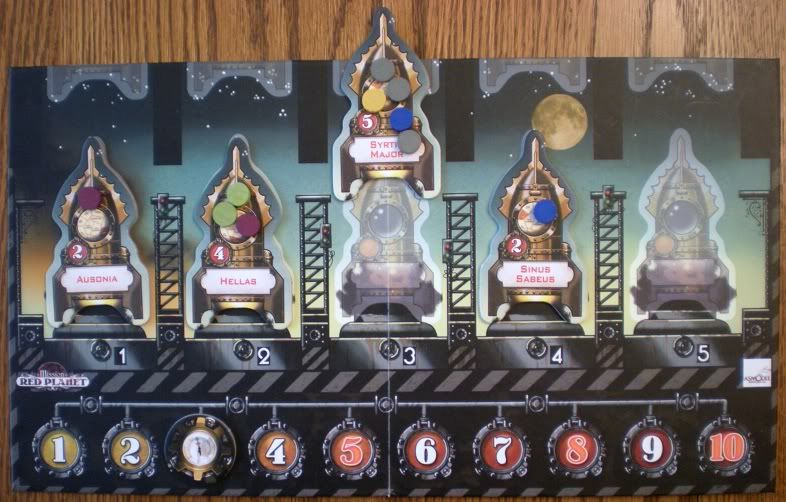 | |
| The launch pad. |
First of all, gameplay is smooth and easy. It is not heavy on rules. At the beginning of each round, you'll secretly select which character you want and take your turn as each is revealed in order. Each person has the same set of role cards, so it's possible you'll select the same role as another player in any given round. Regardless, the character cards clearly define what actions you make take, how to perform them, and where. The two in-game scoring rounds are a also very simple matter. The only bit of confusion comes in scoring at the end of the game, since the Discovery and Bonus cards can change up how points are awarded.
Gameplay is also fast! The game consists of exactly 10 rounds, with scores tabulated after rounds 5, 8, and 10. This limit keeps the game consistently at 60 minutes or less. It also adds a good deal of excitement and tension since you never seem to have quite enough time to do everything you want. Individual turns are also brief. Essentially you place astronauts on a ship and then perform your character's special ability. Then it's the next person's turn. This keeps downtime to a wonderful minimum.
The theme is fun and on the lighter side. The characters generally work and their abilities make sense. Not that I'm asking for realism in a game about steam power launching rockets to Mars in the Victorian Era. Still, I'm not sure how the Femme Fatale makes sense in the scheme, nor what the ability to switch astronauts has to do with the archetype. She could have been a ninja, robber baron, or voodoo witch doctor, for all that. In any event, the unique and creative theme makes for an enjoyable hour of gameplay and helps sooth the burns of conflict.
The spite aspect I think will really make this title a "take it or leave it" extreme. You'll either take it in stride with the understanding that its a central mechanic of this game's design. Or you'll leave it because it'll cause too many fights and heartaches. However, the spite is mitigated somewhat through the limitations of role selection. Once you play a character, you cannot play that role again in future turns until you spend one turn playing the Recruiter. He allows you to collect all previously used characters so that they are available again in subsequent rounds. Therefore, you're not able to kill off opposing astronauts turn after turn after turn, ad nauseum. Also, the non-spiteful roles provide other abilities that are too beneficial to ignore. You simply can not spend the entire game going after the other players. In a two-player game you might win with that strategy, but I imagine that is the main reason this is a game for 3-5 players.
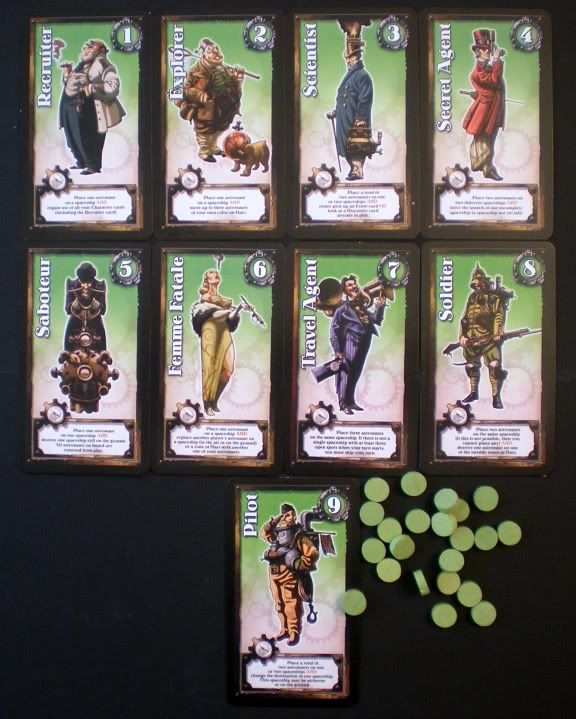 |
| The cast of characters. |
Now while the interaction isn't necessarily incessant, I don't mean to minimize it's impact. When you are attacked, it can really be rough and derail your plans. Since you have so few turns to implement any strategy, one well-timed attack can really cause irreparable damage. Also, Discovery cards can be played secretly in certain regions which change the way they are scored at the end of the game. So even if you have the majority in the region, it may not matter. The Scientist role does let you sneak a peek at a card so you can avoid or prepare for any surprises; but if a lot of them are put into play, the percentages start mounting against you. And then there are Bonus cards. Some assign you a secret mission to accomplish by the end of the game for extra points. There is some strategy in completing these missions, as long as another player doesn't derail them! Then others just randomly give you extra points without any effort exerted on your part. The balance here is that these factors affect all players equally. But that may provide little consolation to heavy strategy gamers who like to have most of the control and information at all times.
Okay, I'll Shut Up Now:
In the end, I give Mission: Red Planet an 8 on the Geek scale (Very good game. I like to play. Probably I'll suggest it and will never turn down a game.). Despite the abruptness of the interaction, I would recommend this title as a sort of "gateway" game to introduce your kids to conflict and spite. There are many hobby games, even typically peaceful Euros, that utilize some sort of "take that" mechanic in which you can attack your opponents, or otherwise mess with their plans. The sooner they learn to deal with it as a good sport, the better. This smooth, brisk, and creatively themed title provides a quick gameplay experience that just might serve well in easing them into that transition.
September 19, 2011
Gaming with Kids: The Train Set Syndrome
I'll be honest. Nostalgia was definitely the catalyst in introducing my kids to hobby gaming. Hence the reason we began with Axis & Allies, probably a bit too soon for my boys' age. In junior high and high school I spent an inordinate number of late nights board gaming with friends. As this was before the influx of German hobby games to the United States, we played war games. Mostly it was Risk and the Gamemasters Games (A&A, Shogun, Conquest of the Empire, and Fortress America). We also enjoyed some select titles of the old Avalon Hill style, hex and counter, strategy simulations. We even dabbled in painted miniatures war gaming. Oh, how the plastic and cardboard and tempers would fly!
After a much greater deal of success in switching to Risk with my boys, I decided to hop on the Internet (also not around back in the day) to see if there happened to be anything new in strategy gaming in the last 18 years. Oh, boy! Suffice it to say, I now have a wishlist five Excel pages long and unhealthy dreams of great shelving and a fatter wallet.
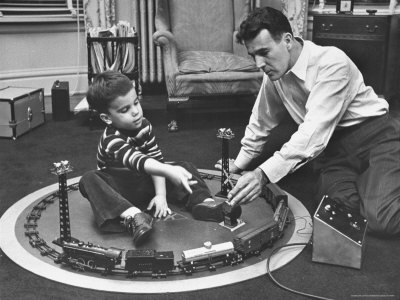
Which brings me around to thoughts of the stereotypical train set. (Any other kid's gift may fit here, like, oh, I don't know...board games?) You know what I mean, right? Dad buys son a train set for Christmas. Dad builds train set. Dad plays with train set. Dad buys more track, cars, and scenery to expand train set. Dad spends small fortune to build replica of the Shenandoah Valley that takes up most of the basement. Dad now has new hobby subscribing to train set magazines and going to train set conventions. Mom decides on future Christmas presents for son.
So again, being honest, there is no doubt I really enjoy "buying games for my kids" simply because I enjoy the hobby. However, I want to be careful not to go overboard. And that's hard to do when reading about cool games and conventions. Practically speaking, I am not able to go too terribly overboard. I have a budget that restricts my purchasing power and a wife that would axe half of a 100 game collection for want of storage space.
But at the same time, it's about more than just those tangible excesses. I don't want to overload my kids with board gaming at the expense of alienating or frustrating them. I don't want to turn it into something for them that it's not - which right now is simply a way to spend fun, quality time with dad. In essence, this really all boils down to an analysis on why I play board games with my kids. That is a similar question for any hobby gamer: why exactly are you a gamer? I've already established the fact I enjoy board gaming as a hobby, in and of itself. I also enjoy quality time with my kids. They always enjoyed board games like Clue, Sorry, and Life. So the jump to hobby gaming seemed a perfectly reasonable and natural fit. But there are many other hobbies and past-times I could have chosen to engage in with them. So why gaming?
Economic Value. Okay, so any enthusiast can drain his bank account in this hobby, as in any other, so this is always relative. Moderation is still the key here. But generally speaking, board gaming is a good investment. If you take care of the game, it will provide you with innumerable enjoyment over the years without requiring any maintenance, making the plays-per-cost ratio very reasonable as compared with many other hobbies or leisure time entertainment. Even if you add an expansion or two to a favorite title, that economic value is still very good. If your collection grows like a hungry gremlin, well then that factor becomes problematic as you don't have time to play all those games. But in our experience, gaming beats a night out at the movies (which gives you one bang for your buck) or model rockets (constantly buying new engines, wadding, etc.). For a family budget, this is one of the more significant attractions to gaming.
Accessibility. I like to get the kids out of the house. I'm of the old school thinking that the outdoors won't kill them. So we ride bikes, play sports, and jump on the trampoline (did you know that if your timing is just right jumping at the same time, you can really launch your kid into the air?!). And we kick them out to play with the neighborhood kids. That said, conditions aren't always optimal to be outside, in which case board gaming is a very appealing option. It usually requires little preparation time and is easy to put away. You can squeeze a play in between other daily commitments since many games only need an hour or two. A game's space requirement can be an issue, but usually you can carve out the room at home. And while certainly not the case with every game, there are still many that are easy to transport on vacations, trips to the grandparents', or other outings. The trampoline is still a bit difficult to get in even our 12-passenger van.
Mental Exercise. Even with heavily random, luck-based titles, hobby gaming gives the brain a work-out. While not solving advanced algebraic equations or debating physics with Stephen Hawking, you are still working the old gray matter. Board gaming forces you to think critically, plan ahead, and adjust to changing situations. I appreciate that this will not guarantee my kids a scholarship to Harvard or Yale, but it is certainly better than video games of the first-person action genre that is so popular today. And while lengthy strategy games can offer some of the same benefits, advances in computer technology will not make board games obsolete!
To be sure there other reasons I choose board gaming for quality time, many of which are for things I am not. I am not musically talented. I am not artistically inclined. I am not socially connected. You get the idea. But I am conscience of the need to keep this hobby realistic with my kids. I want it to be "theirs" as much as it is "mine." Otherwise, it's not really quality time. Besides that, it makes it easier to convince my wife that the kids need another Boards & Bits gift certificate for Christmas!
September 17, 2011
Gaming Report: Mission: Red Plant
Today we played Mission: Red Planet, Cory's favorite game. I like this game because it is really fun and easy to play. I like how the Discovery cards can change the ending score so you never know who is going to win until the very end. This time it was not as crazy because there weren't as many Discovery cards played. But there were a lot of rockets blown up and we were killing off each others' astronauts. It was really funny when dad's rocket got blown up with 3 astronauts on board! In the end, dad won with 48 points, I had 38, Hope had 34, and Cory had 31. It was a close game! :)
Subscribe to:
Posts (Atom)