Showing posts with label Reviews. Show all posts

June 20, 2012

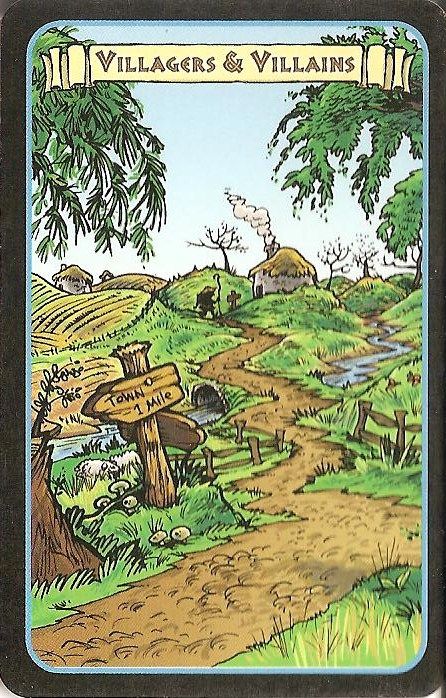
Card Game Review: Villagers & Villains

Villagers & Villains (Studio 9/Aaron Kreader, 2011)
2-5 players / 9 + / 30-60 Minutes
 
Rollin', rollin', rollin'.
Good cards!
Hah! Hah!

Keep rollin', rollin', rollin',
Though your village is gettin’ swollen,
Keep them dice a rollin', good cards!
Through citizens and buildings,
Heroes and villains,
Wishin' my luck wasn’t chillin’.
The good cards I'm missin',
The bad ones seem to be hissin',
“We’re waiting at the end of the line.”

Bring 'em out, lay 'em down,
Lay 'em down, bring 'em out.
Bring 'em out, lay 'em down:
Good cards!

Cut 'em out, throw 'em in,
Throw 'em in, cut 'em out,
Cut 'em out, throw 'em in:
Good cards!
Hah! Hah!

What You Get:

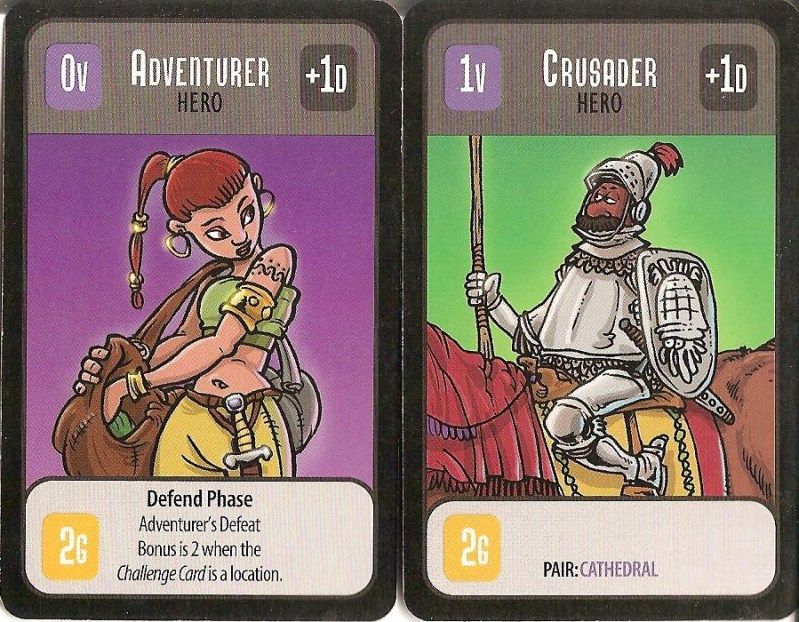
Essentially, cards and tokens.  The tokens are simple cardboard coins (64 total) in denominations of ‘1’ and ‘2.’  There is also a Start Player marker and a King’s Favor marker (used in the advanced game).  The cards are sturdy for an independent press, though not as good of quality as you’d find with, say, Fantasy Flight or Rio Grande.  That is to be expected and not really an issue.  I mean, who doesn’t like to support the little guy?  Anyway, we have played this game a ton and, so far, the cards have stood up and taken very little wear.  Besides, these cards’ appeal lies not in their quality, but in their quantity – Kreader has created a deck of 100 unique cards!  While some powers and abilities are duplicated, each card nonetheless represents a different citizen, champion, building, or challenge with its own distinctive illustration.  He was either very creative or very bored or very both!  He is certainly very talented.  All of the artwork is cartoony and expressive.  The first reference it reminded me of was the old Groo the Wanderer comic books that I read as a kid.  The art is appropriate to the game’s lighter style.  You also get one of those tiny, mini-d6 and a quad-folded, one-page instruction sheet.  Remember: little guy.

The Quick Rundown:

In Villagers & Villains, you are neither a villager nor a villain, but trying to manage both.  You are the mayor of a village trying to hire citizens and champions, erect buildings, and fight off challenges – all represented by cards in your tableau.  The game ends after the round in which one or more players have played eight cards to their tableau, and then everyone counts up their points.  The winning mayor gets a fancy sash.  Game play is divided into five phases which is easier to discuss in dreaded “bullet-point” fashion.  Trust me, I’m just as consternated about this as you are.
  • Recruit  Six cards are laid out in a row, numbered 1-6.  Unclaimed Citizens, Champions, and Buildings from the previous turn are discarded while remaining Challenge cards are moved down to the lowest slots.  Replenish to six cards, as needed.  In turn order, you will announce which card you wish to recruit and then must roll that number (or higher) on the d6.  If your roll succeeds, you may add the targeted card to your hand.  Otherwise, you are stuck with whichever card is in the first slot, so aim low when you can.
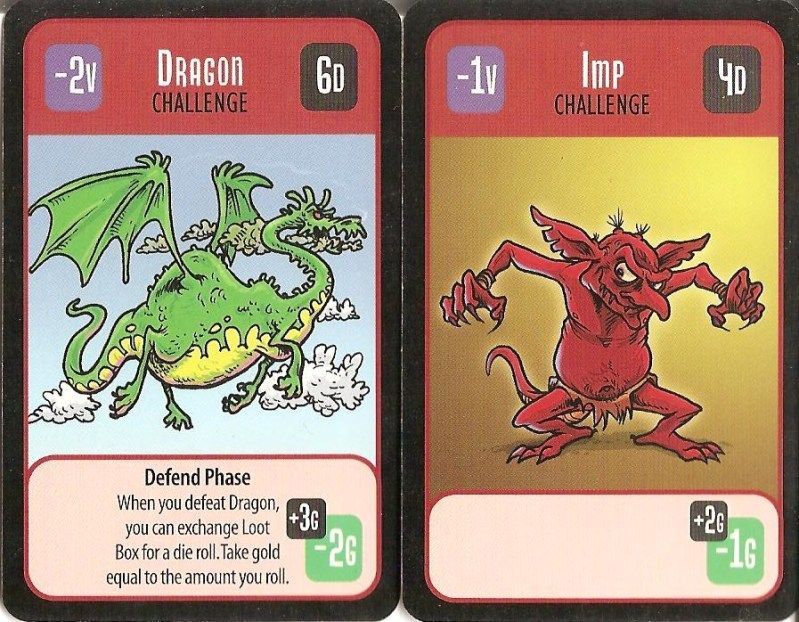
  • Defend  If you get stuck with, or voluntarily take, a Challenge card in the Recruit phase, you now have to roll to defeat it.  You always have a base town defense, but Champions give you better defense rolls and more of them.  Victory means gold now, and possibly points later, while...
  • Pillage  Defeat means the opposite.  Here you may lose gold if you cannot get rid of Challenges.  If they hang around until the end of the game, you'll lose points, too.
  • Earning  Receive the amount of gold as indicated by Citizens in your city (not your hand).
  • Build/Hire  From your hand, you may hire one Citizen or Champion or build one structure per turn, paying the required gold as indicated on its card and playing it in your tableau.  Citizens give you income each turn and maybe a special ability.  Champions help defend against Challenges.  Buildings provide points and may offer a special ability, as well.
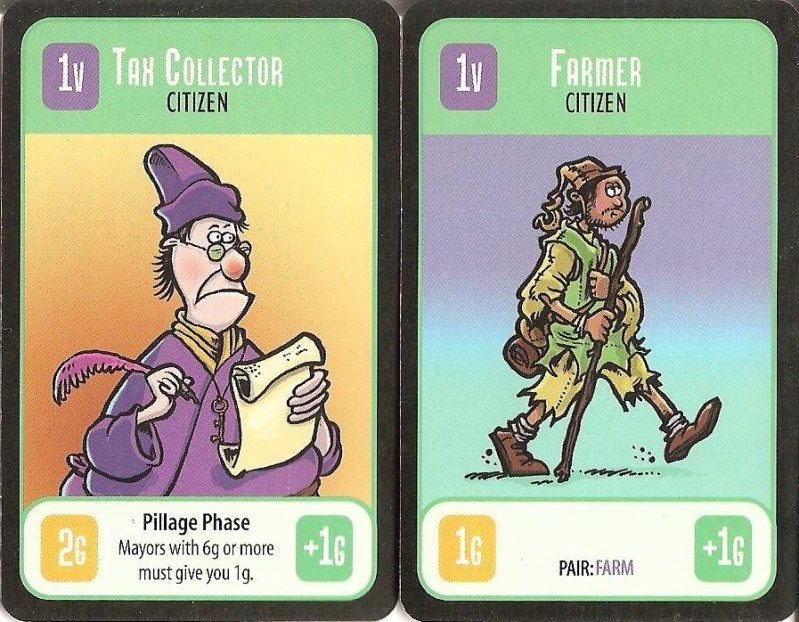

Besides the point values you can earn listed on the cards, you can score bonuses by pairing certain cards together, or having the most Champions, or defeating the most Challenges, etc.  There is a handy-dandy score sheet, yahtzee-style, to help in bookkeeping, as the end-of-game tallying is actually the most complicated part of this title, believe it or not.


E for Everyone:


You’re certainly welcome to bring your finely honed strategic mindset into this game.  Just don’t think too hard.  And you can definitely plan to build your tableau in an efficient, machine-like, point-scoring manner.  But don’t bet the house on it.  This title is fun, as long as you don’t pretend its something grander than you want it to be.
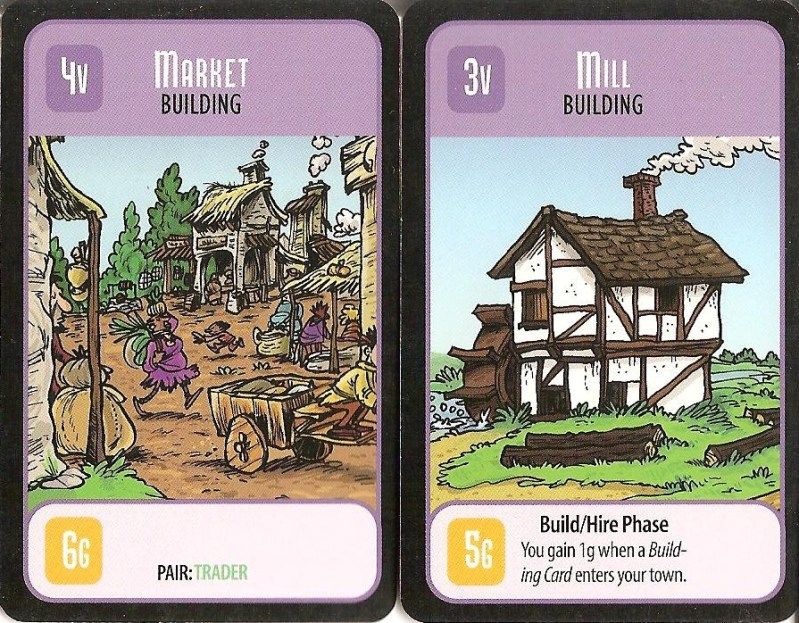


By and large, luck and die rolls tend to be great equalizers in the hobby.  Villagers & Villains has those in spades.  This will turn-off serious gamers only interested in titles that give the old gray matter a workout.  But for those looking to engage in some good, frothy fun – especially with the kids – this card game will scratch the itch.  The rules are light, game play is straight-forward, game length should always be under an hour, and the randomness gives all ages a fair shake.
Let me re-summarize that unpredictable nature, as it is probably the make-or-break factor for most gamers.  Random element #1 begins with the cards in the recruit phase.  Other than left-over challenges from the previous round, you have no idea which cards will be available until they pop up that turn, which makes planning problematic.  Random element #2 lies in turn order, which is connected heavily with the order of the cards in the recruitment pool.  Sometimes going first is advantageous if there are good cards in the first half of the pool, thus easier to nab as fist come, first serve.  On the other hand, if the better cards are in the 4-6 slots, then going last can be advantageous in making it easier to roll for those higher cards which slide down in slots as the cards below are taken.  Random element #3 is then, of course, simply rolling for the card you want.  On top of that, any non-challenge cards leftover are discarded, which often results in a wanted card removed for the rest of the game!  Random element #4 constitutes defense against challenges as you must roll certain numbers to defeat them.  And finally, there are even some chance rolls and card draws in the special abilities, which rounds out this discussion with random element #5.

So how are we able to overcome such chaos?  Well first and foremost, we actually enjoy rolling dice.  Many gamers do.  In addition to its equalizing qualities, dice rolling provides a fair amount of tension and laughter in equal parts, which is sort of ironic and fascinating when you stop to think about it.  That aside, there are a few ways to roll with the chaos.  First, you can grab cards that help to minimize the luck.  Some cards provide aid in recruitment and defense rolls.  Others allow you to draw extra cards by paying gold or defeating challenges.  You can also simply purchase more dice during recruitment.  Second, the advanced game includes the King’s Favor token which is, ironically, randomly placed on a card in the recruitment pool and then awarded to the player who earns that card.  The King’s Favor can aid in recruitment, defense, income, or turn order.  Once used, it is returned to the recruitment pool for the next round.  And finally, there are multiple paths to victory, just in case you find yourself forced down a particular road.  You can stock up on gold-producing citizens to buy the high value buildings.  You can go for a village full of champions to get the hero bonus.  Or you can even willingly take on and defeat the most villains for the challenge bonus.  And if you feel particularly lucky, punk, aim to play matchmaker and pair up certain cards in your town for extra points.
Okay, I'll Shut Up Now:

In the end, I give Villagers & Villains an 8 on the Geek scale (Very good game.  I like to play.  Probably I'll suggest it and will never turn down a game.).  The randomness will sometimes ruffle your feathers, but just remember that you're not the only bird in the nest.  Once you learn to take the chaos in stride, you'll find a light-hearted, adequately themed game that is enjoyable and accessible for a great range of ages.

April 20, 2012

Board Game Review: Dust

Dust (Fantasy Flight/Spartaco Albertarelli and Angelo Zucca, 2007)
2-6 players / 12 + / 60-180 Minutes

Some guys have all the luck.  You know the type.  They had the good mommas that didn't hit the hooch and the daddies that didn't run off with the tramp next door.  Yeah, now those guys ride down the street in their long, black DeSoto to their grandpappy's bank where they sit on their saddle pads all day as a vice president throwing around million dollar bills and go out at night with some classy broad hooked to one hand and a tonic in the other.  I'm not one of them guys.  I hate them guys.  So you can imagine my surprise when she walked in - like I was cold-cocked by a Joe Louis left hook.  Tall, lean, swank, sober, she was quite the dish.  She was 100% glamor, with legs that went all the way up, and knew it.  Bold and confident she walked in.

"What's a dame like you doing in gin joint like this?"

She smiled innocently and sang sweetly, "Well, Sam, I'm your new commander."

I looked her up and down incredulously and smirked.  "Well, it sure is the modern man's new army, eh?"

"Hmpf," she shrugged her shoulders, "a girl's gotta make a living.  Now go ready my mech.  I'm feeling a little gypsy and it's time to give the other side the big kiss off."

Yeah, some guys have all the luck...

What You Get:

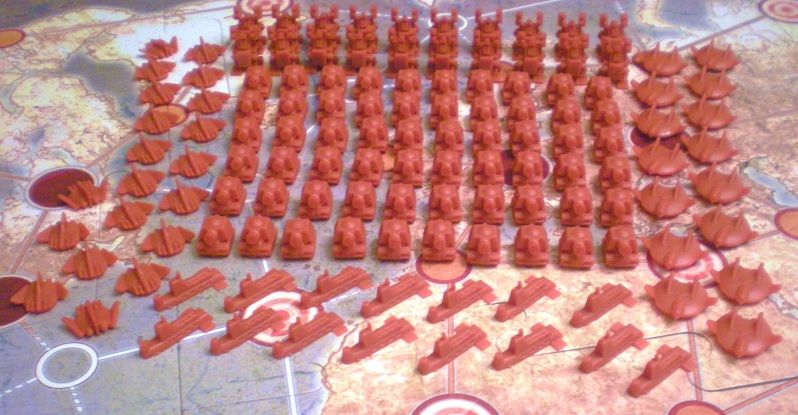
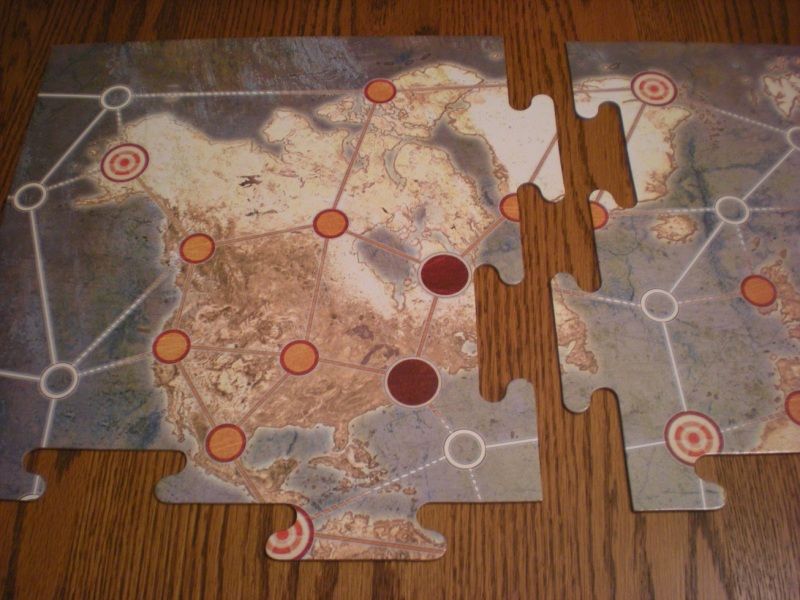
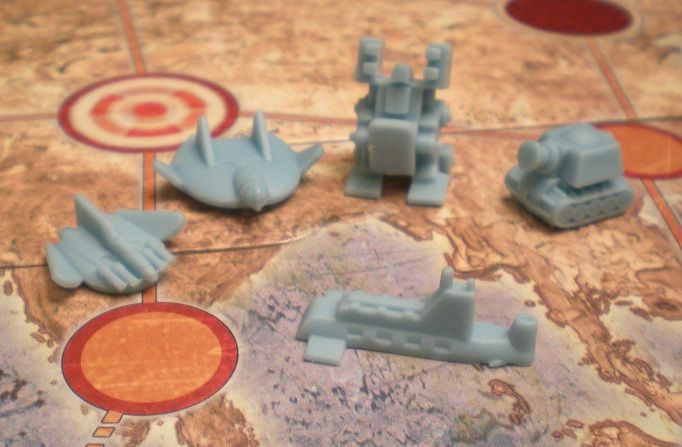
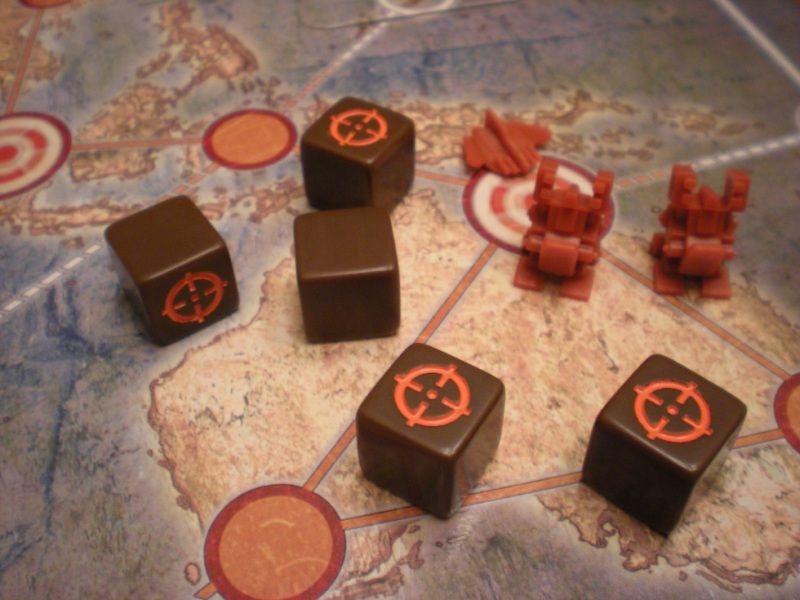
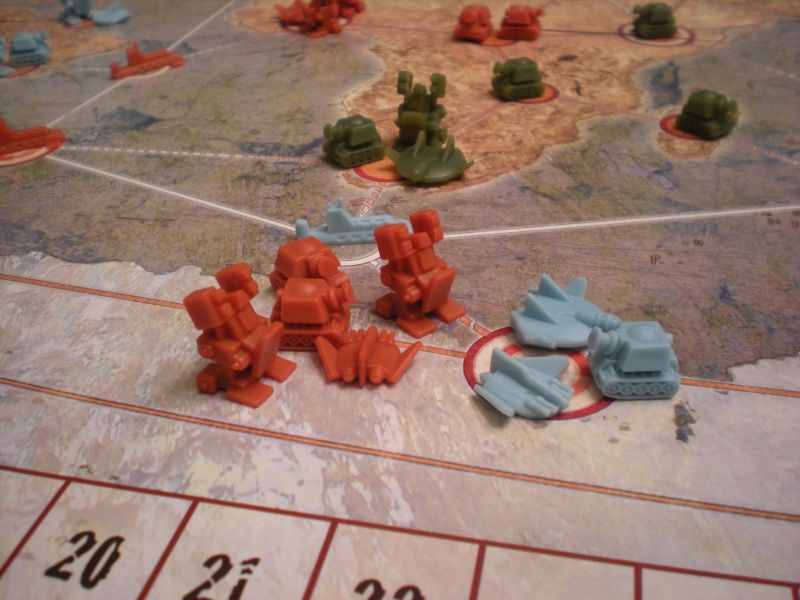
Enough plastic to make an Arab emirate even more wealthy.  Specifically about 780 miniature army pieces!  That's 130 for each player!  The majority are little tank figures, with a number of mechs, fighters, bombers, and subs thrown in for variety.  All are well molded and compact to avoid arms or attachments breaking off, yet still retain fine detail.  And while the game is fiddly, don't stress that you'll have to deal with all 130 of your pieces - you shouldn't come close to using them all, unless you're turtling, in which case you'll lose.  The board/map-of-the-world is unique in both its minimalism and construction.  The stoic map with muted colors is devoid of any geographical references and it's six pieces fit together like a puzzle.  It looks sharp in a subdued kind of way and uses connected circles to denote areas, as opposed to the more familiar political boundaries.  The puzzle-style fitting is unnecessary - it does not lay flat and creates a noticeable warp.  A collection of little factories round out the plastic bits while a handful of cardboard tokens are included to ease in score-keeping.  There are 10 solid, custom, six-sided dice used for combat resolution.  And finally, the game provides a deck of sturdy, linen-textured cards.  These are all imaginatively illustrated and highly expressive.  If playing with children, especially young boys, note that the artwork tends to exaggerate female features, although the only overly-ridiculous image (still not explicit) is on the last page of the rule book and thus easy to nonchalantly set aside.

Your legion of Mechs and Victoria's Secret models await!
The Quick Rundown:
A bit wonky.
Could have done without the puzzle.


Dust is a world conquest war game with dudes (and dudettes) on a map.  But it is a unique world conquest game.  First of all, you accomplish this domination with massive mech warriors, stolen alien technology, and fashion supermodels.  And so while you'd logically expect the major capitals would be Paris, Milan, and New York, actually all political identifications and references are nonexistent.  Instead, your fearsomely, fur-coated Frauleins will simply fight over anonymous circles.  Particular locations of alien technology, evenly dispersed about the globe, become more important than major urban centers in this alternative, pre-WWII setting.  You see, apparently a careless E.T., or two, left some advance weaponry laying about for some Axis and Allied explorers to find and exploit.  You will lead a faction in its bid to control and consolidate these new powers to make dang sure one of your models gets the cover of the SI Swimsuit Issue to debut in about 30 years.

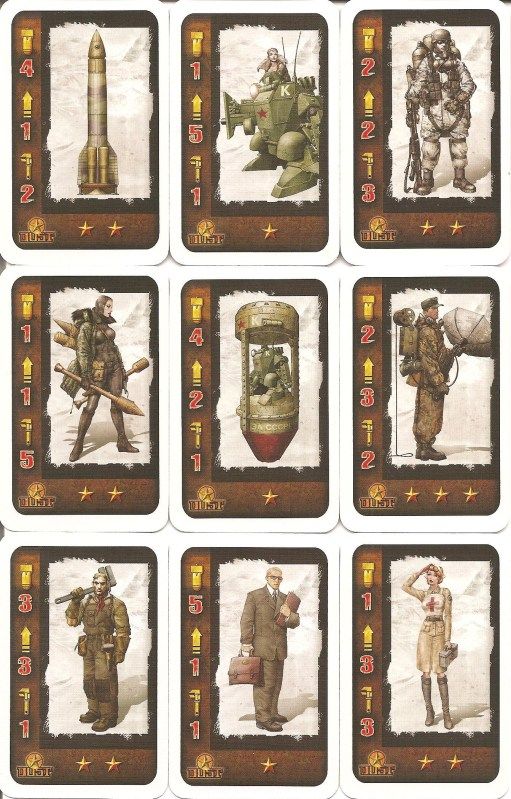
The most entertainingly unique mechanic of Dust is the card deck.  You begin with a hand of five cards and are able to purchase more throughout the game.  At the start of each round, all players will secretly choose one of their cards and then reveal them simultaneously.  The card you pick will determine what order you play that round, how many production points (money) you can spend to purchase new units, how many times you can move, and how many times you can attack.  On top of all that, it will also have an illustration that gives you a specific role that round and a certain rule-breaking ability.  For example, the nurse gives you a chance to save battlefield casualties, the mech dropper allows you to airlift as many mechs from around the world into one battle (very powerful), and the ballistic missile gives you a free bombardment against one enemy zone.


Fighter, bomber, mech, tank, and sub.

Battles are also quite different from many standard titles of this genre.  The custom dice create quick and simple fights where a unit gives you a set number of dice to roll.  The card you choose limits both your movement capabilities to maneuver for an attack, plus the actual number of battles you are allowed to declare that round.  Movement is quite abstracted, especially amphibious or naval transport.  And going into enemy production centers and capitals can be a murderous proposition; so in a sense, kind of like Paris, Milan, and New York, after all.

E for Everyone:

While most other dudes-on-a-map war games are just above the 'E' rating, in my opinion, Dust is just simplistic enough to slip in under the 'T for Teen' barrier.  The primary reason for this is that Dust is a very close Risk clone, whose added moving parts are not overly cumbersome.  It has varying unit types, card play, and a different means of production, but they are all still nicely  streamlined.  In fact, the combat resolution mechanic is even simpler than in Risk.  On top of that, it will not take you as long to play a game of Dust, though not to fool you into thinking it's a short affair.  'Long' is a relative term in the war gaming genre.

Groovy dice.

It regards to game length, the victory point track is a nice addition for gaming with kids.  Now, there is an "epic" version or rules set, if you want to spend an entire afternoon.  However, the "premium" rules set is just right for an enjoyable experience of conquest gaming with children or maybe even other hobby gamers not used to the genre.  You earn one point for each capital and resource area that you own, plus one point for each majority you may have in number of production centers, land areas, and sea areas.  As soon as one player has reached a designated threshold at the end of any given round, they are declared the victor, much like the way we finally defeated the Kaiser in 1918.

As much as a victory point track may seem as inappropriate to a war game as a Rockefeller in Wal-Mart, the mechanic is ideal for younger kids in that it focuses their energies on those targets necessary to achieve victory points.  The strategic scope is more refined, and thus not as intimidating or overwhelming.  Sure, this will turn off seasoned grognards who like to strut around like Napoleon with economy of force, flank attacks, and envelopment, but it sure is a blast for quick and brutal smash-mouth slug-fests.  This is not a game for the prim and proper, gold-tasseled, dandies of the General Staff.  But for the mud-slinging, rifle-toting, over-the-top trench grunts - yeah, this is their cup of tea.

The card mechanic also works to hone a strategic focus and reduce individual turn length, as well as throw in an unpredictable element which adds to the fun.  First off, the card you choose each round gives you some extra production points to add with those earned from your factories and resource areas.  It also gives you a set amount of moves and attacks.  However, it is never strong in all three areas.  So from your hand, you have to decide that round whether you want to focus on building up your forces, maneuvering around to protect your interests and set-up for an assault next round, or just go all out on the offensive.  Because you won't be able to do all three.  Then again, you may want to use the card instead for the ability it provides, rather than worrying about production, moves, or attacks.  That's because playing the right role at the right time can prove invaluable to your situation and/or significantly derail another's plans.  Of course, don't forget that the reverse is true, as well.

The invading horde!

Combat is as simple as it is brutal as it is unique.  First, you compare all the units on each side to determine who has "tactical supremacy" and, therefore, who rolls first - which is a huge advantage.  Then, you simply count up how many dice you get to roll based on what kinds of units are in the fight.  For every "target" symbol rolled, you knock out one of the enemy (in a certain order).  The unforgiving element rearing its ugly head is that knocked out units don't get to return fire...hence the advantage to rolling first!  Production centers and capitals give extra dice for defenders, plus the defender has automatic tactical supremacy in capitals.  So while those sweet victory point targets may be as tempting as honey, remember it's still on the comb and in the hive!

The game is not completely void of drawbacks.  In 4-6 player games, downtime between turns is still an issue, and indeed downtime always seems like an exacerbated problem when playing with kids.  Confrontation, while victory point oriented, can still be contentious since this is essentially an "every man for himself" title.  Temporary alliances can always generate some personal chagrin from the opposing side.  The role cards can provide opportunities to really hammer the point leader and play catch-up, but there is still a runaway leader issue; especially if most of the trailing players are not on the same mental page.  In its worst scenario, that can create an anti-climactic endgame in which the winner is essentially a foregone conclusion, and the last round our two are played on autopilot.

Okay, I'll Shut-Up Now:

In the end, I give Dust the board game an 8 on the Geek scale (Very good game.  I like to play.  Probably I'll suggest it and will never turn down a game.).  It's tight strategic focus, simple combat mechanics, unique and instructive card play, fluid style, and victory point emphasis create an ideal war game for younger kids.  Yet it also retains some nuance that adults can enjoy.  The theme is fun and different, the miniatures of good quality, and the artwork addictive.  After introducing your kids to war gaming with the iconic Risk for its basics in strategy and dice-based combat, I would then recommend Dust as the next step.  Plus, it's a nice change of pace for adult conquest gamers, as well.

The role cards.


April 13, 2012

Board Game Capsule: Word on the Street


Word on the Street @ Let's Play Green Bay!
Designed by Jack Degnan (2009)
2-8 players / 20 minutes / Ages 12+

Another game near Out-of-the-Box's booth was an eye-catching, life-sized setup of their popular, team party game, Word on the Street.  My two boys, nephew, and I were immediately interested.  We popped into the booth to quickly learn the game from a staff member on a table set-up before tackling the monstrous edition.  The game is extremely straight-forward.  Before we finished up with the demo game, another family happened in to inquire about the life-sized version.  Game on!

The board consists essentially of five "lanes" of a street with a number of letters running down the center lane from top to bottom.  There are no vowels and some of the uncommon consonants are also omitted.  Each team owns one side of the board.  On a team's turn, they will flip a category card and must think of a word that fits that category.  Then, spelling it out in proper order, they can move each letter of that word one lane closer to their edge of the board.  Your goal is to eventually move it off the board, at which point that letter is yours.  Collect a total of eight letters in this fashion and you win.  If you come up with a word that has one particular letter multiple times, then you can move it as many times as it appears.  So say the category card reads, "U.S. States," and you say Mississippi - well then that letter 's' is most likely yours!

Word on the Street is a nice jack-of-all-trades title.  With it's sand timer, all-ages access, and potential for humorous results, it certainly fits the party game scene in a similar vein as Taboo, Apples to Apples, and Wits and Wagers.  It is a good choice for the "wordy" and learned crowd that likes Scrabble and Boggle.  Its family friendliness is off the charts as both a fun way to spend time and bond with your kids, as well as a learning tool for categorization, synonyms, and spelling for them.  And finally, I could easily see this as a starter, filler, and/or night-cap for hobby gaming groups - there is a tad bit of strategy in not only trying to think of words (quickly) that will pull letters to your side of the street, but also pull them away from the other team.

I'm not pretending this is a deep game, because it is not meant to be such.  It will lack staying power and probably not be a common or recurrent title.  So just don't over-do it.  As a filler, or a fun activity for family gatherings, or a social ice-breaker, or as a learning opportunity for kids, you can't go wrong with Word on the Street.  In doses, this unique social game concept is simple to learn, accessible to kids, and a blast to play.

April 06, 2012

Board Game Capsule: Pirate vs. Pirate


Pirate vs. Pirate @ Let's Play Green Bay!
Designed by Max Winter Osterhaus (2010)
2-3 players / 20 minutes / Ages 8+

Out-of-the-Box Games had a welcoming booth with plenty of space and a good number of tables for demos.  Curious to try something new as we wandered in, the boys immediately spotted the cartoony box art of Pirate vs. Pirate all set up and ready to go.  My two boys and my nephew eagerly sat down to a 3-player try while a staff member launched into the rules.

This lightly, pirate-themed, abstract game sort of struck me as a combination of chess and capture the flag.  You begin the game with 6 scurvy, scallywags (nicely molded plastic figures) in your own little corner (think boat) of a unique, triangular board with triangle spaces.  In the center are three silver coins and one gold (all cardboard tokens).  On your turn, you roll two 4-sided dice and then move one of your pirates that many number of triangles.  The object is to run and nab the coins and bring them back to your boat/corner.  If you collect two of the silver coins, or the one gold coin, you win.  Now, don't let the cartoony caricatures fool you.  No, sir, these are blood-thirsty, murdering scoundrels and your opponents are not going to just let you drift in and claim the booty like rowing on a spring-day afternoon with your sweetheart on the lake.  If you roll an exact number of spaces, you can land on an opposing buccaneer and kill him, sending him to Davey Jones' Locker - which is horrible since he hasn't washed his gym shorts in ages.  If the unfortunate soul was carrying a coin, it's now yours.  Yep, in this game, you have to kick some booty to get some booty!  Then again, if it's just blood ye be after, you can always win by the cutlass, instead, and wipe out all of your enemies.  Of course, in that situation, I guess all the treasure lying about would be yours by default, anyway!

As you've probably deduced by the short paragraph of rules - made longer than necessary by bad jokes - this is a simple game.  It is also fairly quick.  Our 3-player, first-time demonstration game took barely 20 minutes.  It does offer some interesting strategy and cost-vs-rewards decision making.  After you have a coin or two in your possession, do you race back to the boat?  Or do you send out more of your men to block or sacrifice himself to take one for the team (I'm pretty sure that's un-thematic!).  An interesting wrinkle to securing loot is that all your pirates begin in your boat.  However, there must be an empty spot, or two, at the back in order to place the treasure.  And there's no jumping over other guys.  Furthermore, you have to roll an exact number to put the booty in your dinghy (okay, I'll stop now).

The challenge becomes protecting your loot while maneuvering for free space and waiting to roll the right number to bring it aboard where it'll be safe.  Plus, you must weigh that balancing act against the need to go after the other players before they can grab their own winning haul.  Even if you're not strictly targeting an opposing pirate for his coinage, you still may want to simply knock off an innocent bystander when advantageous to do so.  After all, they're not so innocent and may be gunning after you next!

I have no doubt that this enjoyable title is an excellent, puzzle-solving exercise for kids in the same manner as Chess, Checkers, or Go.  Yet here, the pirate theme adequately masks its abstractness to be a hair more engaging than those others - at least for kids.  I'm not sure it would appeal to adult, hobby gamers as anything more than a light diversion in the long-run.  There's just not a whole lot terribly memorable about it.  My boys really liked their one play and asked me to buy it, though I did not.  I went ahead and put it on our wish list for now, but not as a high priority.  One, it only suits 2 or 3 players, although admittedly it's quickness could negate that personal drawback.  But also in just knowing my kids, I'm really not convinced it will be a repeated attraction down the road after the dull of the initial shine.  Still, Pirate vs. Pirate is a simple abstract game, short and sweet, that will hone children's basic critical thinking skills in an entertaining fashion because of its theme - a theme of which I've yet to find that one person doesn't like!

April 05, 2012

Board Game Capsule: Once Upon A Time


 Once Upon A Time @ Let's Play Green Bay!
Designed by Richard Lambert, Andrew Rilstone, James Wallis (1993)
2-4 players / 30 minutes / Ages 8+

While browsing through the game library, a volunteer named Tanner, with Gnome Games, approached us and offered to teach us Once Upon A Time.  This is an older game, but still available in print and it is decidedly much different than what we're used to.  After explaining it as a story-telling game in a fairy tale fashion, I could tell my boys were a bit unsure.  However, I brought them to the convention to experience new things, and I talked them into giving it a try.

As explained by Tanner, Once Upon A Time is a card game that provides a light structure for the players to tell a story.  The goal of the game is to guide the story towards an end that is randomly assigned to you - your version of, "They lived happily ever after."  For example, the ending I had to try and reach was, "And so true love had broken the enchantment."  In addition to your "The End" card, you are also dealt a number of cards that sort of act as plot devices that you must get rid of before you can reach your end.  These cards consist of people, places, items, aspects, or events.  Each time you say one sentence in the story, you are allowed to play one of these cards.  For example, if I had a card that read, "Sword," I could lay it down while narrating, "The prince drew his sword as he approached the dragon's lair."

You will continue to develop the story until you pass or another player steals your turn.  You might pass because you've run out of ideas to keep the story moving along (awkward mumblings and long delays will lose your turn for you) or if you'd like to conserve your cards for later use.  Another player can interrupt you and steal your turn in two ways.  First, he/she can play a special steal card that corresponds to a category that you just laid down.  In the sword example above, some one would need an "Item" category card to play as soon as I laid the sword down (which is an item).  The second way to interrupt the story is by laying down a card that just happens to match something said by the current narrator - yes, it is that completely random!  For example, I was telling a part of the story where a gnome was chasing a queen around his forest lawn and Tanner beamed with joy as he plopped down a "Chase" card!  Any time your turn ends, you draw a new plot card.  And when continuing the story at any point after another player, the only rule is that there must exist some continuity and it must make some logical sense, even if within a fantastical, fairy tale context.

It took several minutes for my boys to get warmed up and even then, they contributed only little nuggets at a time.  Despite their timidity, they generally followed the story's wacky development and contributed in sensible, even imaginative ways.  Our particular story involved standard bedtime tropes such as the queen, the prince, a wizard, a fairy, and a gnome.  We had a dark, enchanted forest, a castle, potions, and transformations.  However, we had a dash of odd creativity, as well.  On top of being ugly, our queen was first turned into a bird, but escaped a cage-trap because the bars were set too far apart, and then she eventually turned into a man (somehow).  And of course, we solved a riddle that queens only cruise the Royal Caribbean lines when journeying upon the sea.

Once Upon A Time is not a traditional game.  The rules and basic structure of play are easy enough to grasp.  The challenge is to be creative and imaginative in trying to steer a corporate story toward your personal end goal, yet still retain logical continuity within the framework that everyone else contributes to the tale.  I'm not sure that a dedicated gaming group should really take this title too seriously.  I think it is designed to create a good time and a fun experience.  Challenging narrative delays and screeching plot disruptions is certainly legitimate, but nonetheless should be light-hearted.  We played fairly loose with plot development when the boys jumped in, but still stopped them short when venturing too far from the storyline or trying to jump ahead of themselves.

Kids are typically very imaginative by nature.  This unique title is a good tool to develop that natural inclination.  Will it be a frequent and regular game brought to the table?  Probably not.  It will probably only appeal to a niche group of adult gamers, as well.  In the right social situation and with the right group of creative gamers, this could definitely provide a roaringly funny time.  But it is not a strategy game in the traditional mold of the hobby.  It will be very hit-and-miss with children, too.  My boys sort of enjoyed the experience, but it was not a game they begged me to buy afterwards.  One specific purpose for which this title might shine is in preparation for introducing your kids to role-playing games.  While Once Upon A Time is not an RPG, it will still get them to creatively think and develop narrative "in character" - and in a smaller and more focused, thus manageable, environment than what RPG's provide.

April 04, 2012

Board Game Capsule: Forbidden Island


Forbidden Island @ Let's Play Green Bay!
Designed by Matt Leacock (2010)
2-4 players / 30-45 minutes / Ages 10+

This is a game my brother-in-law's family owns, though they've only played it once completely through - and that is when they were visiting us.  So my nephew was familiar with it.  I've had it on our wish list for a while, and my kids had certainly been interested.  In fact, if it could play up to five people, I probably would have bought it long ago.  Anyway, we pulled Forbidden Island next from the open library, set it up, and then I jumped into a quick rules explanation.  My two boys followed along and after one turn were up to speed.  This is a very simple game to learn and play.

Quickly, your goal is to work together with the other players to find four different treasures - by any one person individually collecting a set of four cards representing one of those treasures (think rummy, Indiana Jones style).  When a player has a matching set, he/she must run to a designated point on the island in order to pick it up.  Once your team has gathered all four treasures amongst yourselves, then everyone needs to dash off to the helicopter pad where some one must play a helicopter card to fly home.  The kick is that the island is sinking - and faster than the U.S. economy!  After each player's turn, not only are a random selection of tiles flooded, but it's possible that the overall water level will rise, meaning even more tiles will flood each turn.  If a tile is flooded twice, it sinks completely and is removed from the game, creating an impassable gap between other tiles.  Not only that, but if enough treasure location tiles sink to where you can no longer collect a required treasure, the game will end.  Luckily, you are able to "shore up" a partially flooded tile before it floods a second time, but really you're only delaying the inevitable.  Speed and mobility are the core principles you'll need to survive as you race around to shore up sinking tiles and to trade cards so that individuals can collect those precious sets.

Turns are dead easy and quick.  You have three actions per turn, one of which consist of one of the following: move one tile, give a Treasure card to another player on the same tile as you, shore up a flooded tile, or turn in a collected set to gain that treasure.  After you use your three actions, you draw two Treasure cards which are usually a treasure.  However, there are some special sandbag and helicopter cards which give you extra benefits.  And there are also three "waters rise" cards, meaning the overall water level goes up a notch.  If it rises too high, the game ends immediately.  Otherwise, the water level indicates how many tiles flood and you randomly draw that many Flood cards to see which areas flood or maybe even go the way of Atlantis.

With its cooperative nature, simple play, and minimal downtime, this is an ideal family game for kids.  The tiles are laid our randomly every game and you can even experiment with different layouts and designs.  In addition to the normal rules, there are also six different roles from which you randomly assign to players at the beginning of the game.  Each role gives you a rule-breaking ability.  For example, the Engineer can shore up two, adjacent, flooded tiles for the same action point; and the Diver can swim through any number of missing or flooded tiles as an action.  This adds a great deal of flavor and replay value.  There is player elimination if you get caught on a tile that sinks with no adjacent land space to move to, but that ends the game for everybody else, too!  The components are all colorful and beautiful, with little, plastic, sculpted treasure tokens.  The artwork is very nice.  Both the time and age suggestions on the box are slightly high.  Both of my sessions took right at half an hour, but that was with rules explanations.  And kids as young as 6-7 years would be able to handle this title, especially given is cooperative mechanics.  There are four different difficulty levels, which simply translates to how high the water level begins at the start of the game.

Forbidden Island is a fast-paced, tense, and accessible title for kids with a good deal of luck and replayability.  It is great for teaching problem-solving and teamwork.  It is also an "out of this world" value considering what you get in terms of game play and components at a price point of anywhere between a mere $11-$18.  That's just unheard of!  Really the only drawback for our family is the 4-player max.  We have Red November, which is similar in chaotic cooperativeness, but accommodates up to 8 players and is thematically richer, though it is much more fiddly.  However, I can highly recommend Forbidden Island as a family game for kids and adults.  It will remain on our wish list and probably be a purchase down the road.

April 03, 2012

Board Game Capsule: Carcassonne: The City


Carcassonne: The City @ Let's Play Green Bay!
Designed by Klaus-Jurgen Wrede (2004)
2-4 players / 45-75 minutes / Ages 8+

While my brother-in-law was off battling some famous Pokemon champion with my nephew and Brendon in tow, Cory and I jogged over to the open gaming library to pull out a title on our wish list - Carcassonne.  I'm a bit surprised that he's had his eye on this one, but based on videos, he liked the tile matching, the developing map, and the little meeples.  Plus it seems simple and a good game for kids and adults to play together.  So, grabbing a table and opening the box, I soon discovered we actually pulled out Carcassonne: The City, a slight difference in name, sure, but quite a bit different in game play, from what I understand.

Having never played Carcassonne, but knowing a fair amount of the rules thanks to BoardGameGeek, we began play with the rulebook open.  Each tile has a residential area, market, and/or street on it - sometimes all three.  When placing tiles, only streets are required to be lined up or matched.  After placing it, you may also put one of your meeples on the tile in either the residential, market, or street terrain.  If you place one on the market or street, you will score points as soon as that section is completed with subsequent tiles and receive your meeple back.  If you place one in a residential area, then it stays there until the end of the game, at which time it scores points for every market terrain bordering your connected residential areas (complete or not).  The second mechanic includes building walls around the city, which begins in the game's second phase.  In this round, after the first street or market is completed and scored (and for each time after that), players will take turns building wall segments.  This is another way to complete streets and markets for scoring - essentially they end when hitting the walls!  Also, you can place meeples on a wall segment who will score points at the end of the game based on the number of certain historical buildings in tiles of the adjoining row.

C:tC is a shade more complex and subtly more strategic from what I've read/seen of it's original ancestor, but the rules and play are still simple enough.  Upon playing this particular implementation of the famous franchise, I hesitate to purchase regular Carcassonne with has even less features than this one.  Or at the very least without an expansion or two, which I generally do not like to do.  The components are of fine quality and it is fun to watch our city unfold.  However, it is pretty repetitive.  Generally, in shorter games or card games, that is not an issue for us.  But with a bland theme and going on over 30 minutes, my son began to lose interest and focus.  The other guys rejoined us and it did not take much at all to persuade him to quit the game and move on to something else.

There is a significant luck factor in the random draw of the tiles that affects long-term planning.  That is often balanced by the fact that many times an opponent is forced to make a play that benefits you.  Your strategy must be open to allow for a variety of options and you'll soon find yourself struggling to decide how best to place your meeples - especially considering that those in residential areas and on walls stay for the remainder of the game.  We actually prefer some luck in our family games and I like the concept of teaching my kids to adjust their plans on the fly, when needed.  However, the lack of conflict, bland theme, and (in the end) repetitive play will sink this one near the bottom of the wish list - of which it was namely on just for it's iconic status, anyway.

March 28, 2012

Card Game Review: Briscola

Briscola (unknown / 18th Century)
2-6 players / 8 + / 15-60 minutes

Kid #1: "Dad, what are those bolt-looking things again?"

"Um...that would be the 'cups' suit."

Kid #2: "Wait, how do you tell the ace of swords from the ace of batons, again?"

"Like I said, the ace of swords has the two chickens and the ace of batons only one."

Kid #3: "Where's the queen?"

"No, the queen is in the standard cards. These have knights, instead, remember?"

Kid #1: "The queen's a 'he?'"

"No! Well, yeah, from your point of view, sort of..."

Kid #4: "...are the swords curved or straight?"

Sigh.  "Most are curved, but some are straight."

Kid #2: "But the batons are straight!"

"Yeah, but they have little knobby ends."

Kid #3: "What's the king and the jack?"

"The kings are wearing the crowns.  And numbered 13 in the top corner.  Jacks are numbered 11."

Kid #4: "Well, if there aren't any 8, 9, or 10s, then why is the jack 11?  Shouldn't it be 8?"

"I don't know know!"

Kid #2: "Do you have any other cards?"

"Hmmm...well, I do have this German-suited pack..."


The Quick Rundown:

Briscola is a fun and unique point trick taking card game that is extremely popular in Italy and found in many variations throughout Mediterranean Europe.  It is not well-known in North America.  Using a 40-card pack, it is even more fun and unique when played with one of the traditional, regional Italian card decks.  You can also play with a standard, 52-card, French-suited deck by removing all of the Tens, Nines, and Eights. Cards rank A-3-K-Q-J-7-6-5-4-2.  In the Italian-suited decks, there are no Queens, but instead a Cavallo (horse/knights) and the Jacks are Fante (or infantrymen).  Instead of clubs, spades, hearts, and diamonds, the Italian suits are batons, swords, cups, and coins.

Basic game play is straight-forward.  In the 2-, 3-, 4-, and 6-player games, everyone is dealt three cards (in the 3-player version, you must first remove one of the Two's from the deck for a total of 39 cards).  The top card of the draw pile is then turned up to determine trumps for that round and placed face up under the draw pile so that the suit is visible.  Play then proceeds counter-clockwise; so the player to the dealer's right begins by leading a card of his choice.  Subsequent players do not have to follow suit nor are they obligated to play trump, if possible, but instead may play any card.  The highest trump card, or if no trump is played then the highest card of the suit led, wins the trick.  Beginning with the winner of the trick, each player will now draw a card, bringing their hand back to three cards.  The winner of the previous trick leads to the next.  When the draw pile is exhausted (the last player to draw will receive the face up trump card at the bottom of the pile), play continues as normal without drawing new cards until all hands have been played.  Then each player counts the card points in their captured tricks as follows:
  • Ace = 11 points
  • Three = 10 points
  • Re (King) = 4 points
  • Cavallo (Queen) = 3 points
  • Fante (Jack) = 2 points
The player or partnership that scores at least 61 card points (there are 120 points in the deck) earns one point for game. In a 3-player game, it is simply the player with the most card points that earns the game point.  Play typically continues over the course of several hands so that you may play to a set number, or best of 5, or best of 7, etc.  In the 4- and 6-player versions, you are partners either with the player sitting across from you (4 players) or the individuals sitting two spaces away from you on either side (6 players).

The 5-player version is slightly different.  In Briscola Chiamata (or Call Briscola), all players are dealt eight cards, so that there is no draw pile.  Then there is one round of bidding, beginning with the player to the dealer's right.  In one variation, players first bid the number of points they expect to win.  The highest bidder then gets to call one card of a particular suit which determines two things.  First, the called suit is trumps for that round.  Second, the holder of that card becomes the caller's partner for that round.  Play then proceeds as in normal Briscola (sans drawing new cards), with the called partner keeping his identity a secret until he plays the called card.  After all eight tricks have been played the caller and his partner must have earned at least the number of points originally bid.  The other bidding variation involves players calling for a specific card and suit, with the lowest card winning the bid.  That card determines both trumps and partners for the round, with the caller and his partner needing to win at least 61 card points.  In both variations, when successfully winning a bid hand, the caller earns 2 game points, his partner earns 1, and the other three lose 1 point each.  However, if unsuccessful, the caller loses 2 game points, his partner loses 1, and the other players each earn 1.

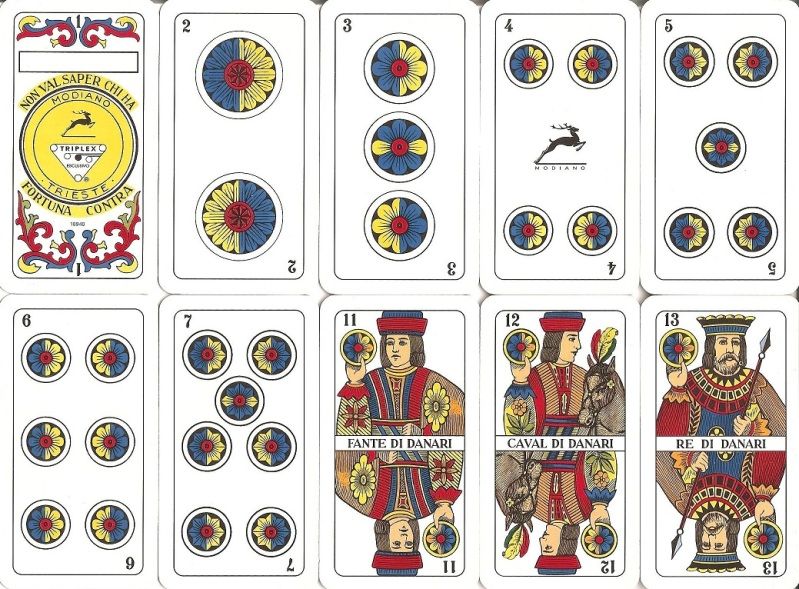
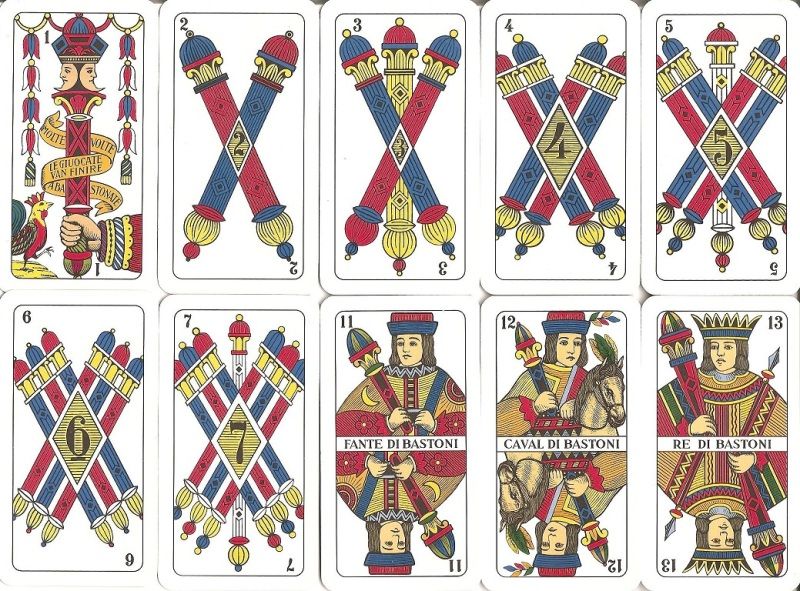
Triestine pattern - Coins

E for Everyone:

There are a lot of point trick taking card games.  Indeed, it is probably the most popular and commonly played genre throughout Europe and the Americas.  Briscola is a very nice primer to the family.  The freedom to play any card you wish without the requirement to follow suit is off-set by the fact that you only have three cards in your hand at any one time.  This creates a manageable situation in which kids can learn how to assess what they're able to win and lose, as well as analyze what they're willing to give away.  In all point trick taking games, there is generally a give-and-take whereby sacrificing a higher point card is worth it to save another of even lower value, especially if that lower card is trump.  Briscola's three-card hand limit and basic rules set really facilitate learning these strategies.

Triestine pattern - Batons
 As with all card games, keeping track of what has already been played influences a large part of your decisions.  The unique, three-card hand limit generally forces a cautious game early on as players maneuver to relinquish the lead and hesitate to risk losing high non-trump cards.  In other point trick taking games that require players to follow suit when able, the lead player is often able to coax opponents into playing cards they don't want to.  That degree of sophistication is not present in Briscola until later in the game (though there is a variant that you can play where following suit is required after the draw pile is exhausted).  This mechanic makes things more accessible for kids, however it may not appeal as much to seasoned card players.  Instead, you're either waiting for opportunities to win tricks with your non-trump point cards or decide when to sacrifice one with hopes of taking bigger prey in later tricks.  There is also essentially what amounts to a "mini-game" on the fourth to last trick as it is generally more advantageous to lose so that you get the last trump card for play in the final three tricks.

Probably the biggest appeal to Briscola is its scalability.  Sure, many card games can be altered to accommodate a number of player variations, but really are only fun when played by a specific number.  For example, you can play Cribbage with 3 or 4, but it was created with 2 players in mind.  Pitch shines a lot better with 4 or 5, despite rules allowing for 3.  Then there are numerous games like Hearts and Spades and Euchre designed for only 4.  Briscola really is just as smooth and fun with any number of players (though I have not played the 6-player version).  I enjoy the 5-player variant the best, but there is enough difference between them all as to keep things interesting and fresh.  And while you may prefer other card games when you have 4 players at hand, this is a superior option for those times when there is the odd number of people; or it is just you and another (and you don't have a cribbage board!).

Initially, the odd card ranking kept tripping up my kids because they forgot that Three's are ranked just below Ace's.  Now, it's just automatic for them, though I honestly can't pin down exactly how many plays it took to reach that point.  It is also helpful, I think, to introduce and teach the game to kids using the Italian cards as they already have presumptions based on earlier experiences with the A-K-Q-J structure of standard American cards.  Of course, there are other games with a similar ranking switch in the Ace-Ten family (e.g., Pinochle), where the Ten replaces the Three.  Briscola's ease of play makes it a nice choice to acclimate kids to that mechanic.  The other possible wrinkle to this Italian gem, ironically, is the open-ended card play.  Most other trick-taking games require players to follow suit and/or play a trump card.  With no such restriction here, an over-familiarity has led to some hesitation amongst my kids to try other trick taking games that have such limitations.  They are too comfortable with the freedom that Briscola gives.

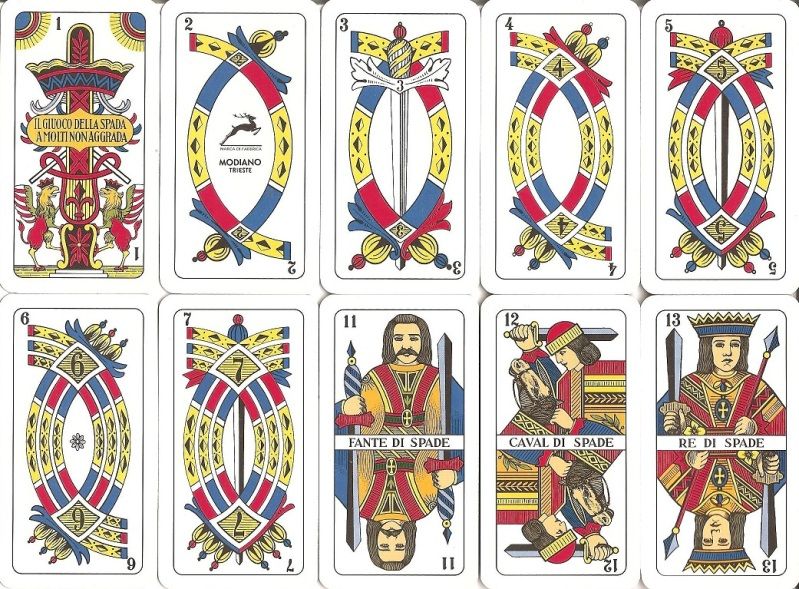
Triestine pattern - Swords

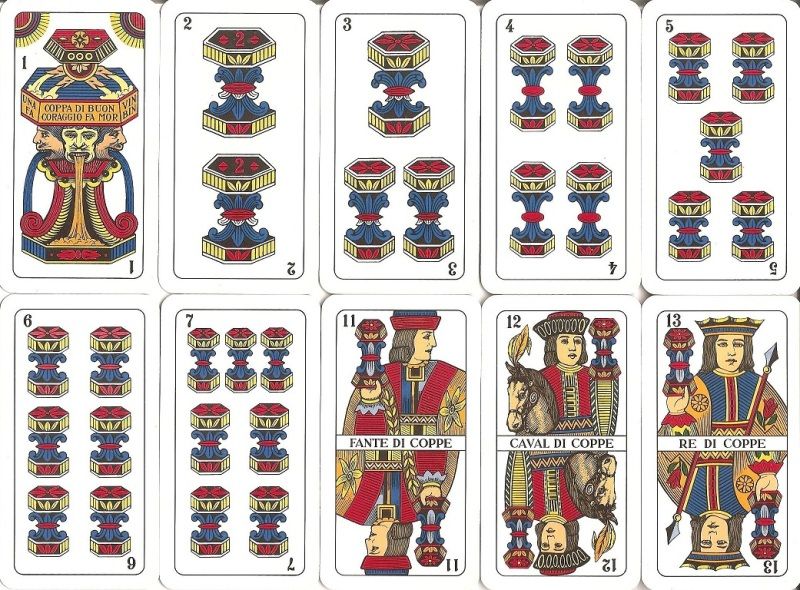
For more authentic flavor, I did purchase some Italian playing cards, having to choose from sixteen different patterns!  The Triestine pattern seemed like it would be a little easier for the kids and I to get used to.  First of all, it has numbered indices, in case there is confusion over counting the number of swords or batons.  Second, the court cards are double-sided like those in a standard deck, whereas most of the other Italian cards have single standing portraits that force you to constantly flip them over so that they're standing upright!  And finally, the words "Re," "Caval," and "Fante," are printed in the center of the court cards to help distinguish each from the other.  I would not say that the Triestine pattern is the most aesthetically appealing, but it certainly seems the most practical for Americans learning to play with Italian decks.

Triestine pattern - Cups

There are several electronic implementations of Briscola.  For the iPhone or iPad, I recommend the La Briscola app.  Although it is two-player only, it is free and has all of the regional card decks available.  Likewise for the BTM Pro+ computer download.  Thanos has an excellent four-player version for free download.  The Pagat.com entry has a handful of other options for download or online versions of the game.

Okay, I'll Shut-Up Now:

Briscola strikes a wonderful balance between light, breezy social game and tense, strategic battle of wits.  This is a good one for children and beginners as it is easy to learn, simple to play, and having just the right card at just the right time serves as an equalizing measure of sorts.  However, a player with a keen memory, experience, and savvy partnership chemistry will have the overall advantage.  It is a good introduction for kids in the point trick taking genre, while Briscola Chiamata adds a bidding element which is common to many card games, as well.  And from an American perspective, the peculiar, Italian-suited cards add a little touch of the exotic to enhance the experience.

March 15, 2012

Board Game Review: Small World

Small World (Days of Wonder/Philippe Keyaerts, 2009)
2-5 players / 8 + / 60-90 Minutes

It was an empire to be feared!  A civilization to be envied!  A people to stay away from!  The great tribe of fortified trolls grew to legendary status.  Carving out a glorious realm, they stamped their footprint upon the land with ominous lairs and massive fortresses.  Only the foolish and desperate dared attack such formidable defenses.  The prestige and honor garnered by such accomplishments would resound throughout the rather smallish world.  Alas, it was not meant to be for eternity.  Stretched thin, even this mighty nation could no longer exert their authority.  Yet even though in somber decline, this once proud people's influence would be felt in their former haunts for many years to come.  Lo, instead, it was time for the rise of the...

...um...

...seafaring dwarves?

What You Get:

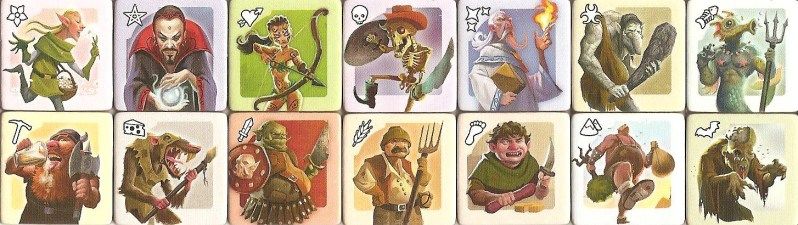
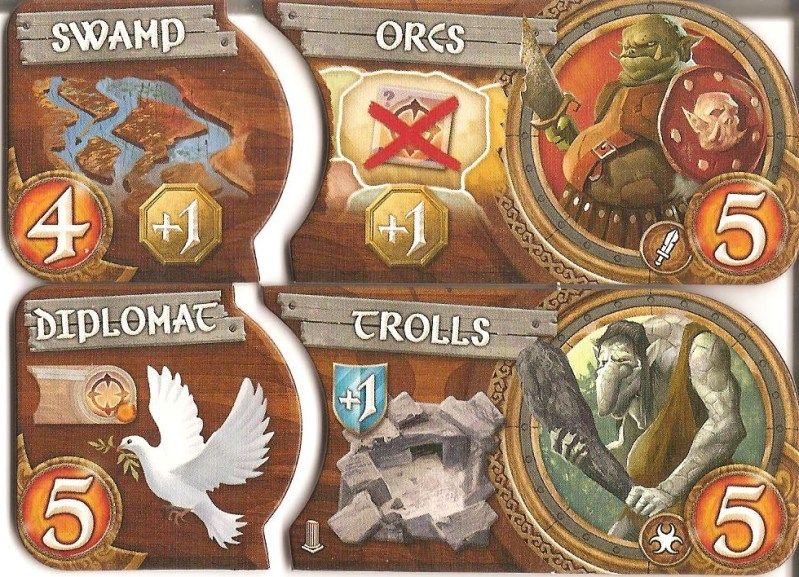
Appearance-wise, Small World should appeal very much to both the gaming and the casual crowd.  While there are no plastic miniatures to be found, there is a lot of extremely sturdy cardboard, all simple, colorful, and attractive.  These pieces are bright, the artwork is vibrant, and the rulebook is breezy.  There are two boards, both double-sided, each face used for a different number of players.  The coins (slash victory points) come in five denominations.  Various other tokens will denote "armies" and defensive impediments such as mountains, fortresses, and dragons, etc.  The last cardboard pieces to note, the heart of the game, are a set of banners identifying the many races available to choose from and another stack of badges to identify rule-breaking powers.  The race banners and power badges are cut so as to pair neatly together as each come up randomly for selection.  The artwork is light and humorous.  While decidedly on the whimsical side, it nonetheless thematically portrays many a familiar fantasy fare without being overly "geeky."  Everything is standard Euro business, but with a delightful panache.  A couple of final notes.  One, there is a very lightweight, wooden die with 1, 2, 3, or no pips on its faces.  And two, the box insert is extremely helpful and well-designed with even a plastic tray (and lid!) to keep all the race tokens organized and in place.  The tray's compartments are a bit small, however, for adult fingers.  But as I game mostly with my kids, it's not a problem - I just make them fish out the pieces!

Cardboard bits galore!
The Quick Rundown:

Like so many other civilizations in history, your goal in Small World is to earn the most victory points; all couched in terms of "conquer thy neighbor."  At the start of the game, 5 race banners and 5 power badges are randomly drawn from their separate decks and then matched together in order.  The player with the pointiest ears obviously goes first and can choose one of the 5 race/power combos on the table to begin.  However, there is one catch.  The first available race is free, but if you see a better race/power combo up the line, you have to pay one coin for each race you skip to avoid a guilt trip.  Those are placed on the people you just stiffed and will go to their eventual owner upon selection.  The banners/badges also specify the number of tokens of that race you receive; these are your "troops" which you'll send forth to subdue this world that is too small.  Warfare is simple math.  An empty region takes two of your race tokens to conquer, plus one more for each additional piece of cardboard occupying it.  Those impediments could be in the form of another player's tokens, or some other defensive obstruction such as mountains or encampments.  After all, everyone knows how stubborn cardboard can be.

Now, as is true of all war games not dealing with Napoleon, you're not just conquering territory for the sake of conquering territory.  No, instead, you want to capture regions that will score you points.  While occupying any old space will indeed earn you one victory point, your race's special ability and unique power will give you even more by going after certain areas or attacking in particular ways.  Each new turn, you'll pick up all of your tokens, less one per territory already owned, and spread the love again as best you can.  With so many race and defensive tokens lying about, the board will very soon be more crowded then my laundry room and you'll be out of men.  "Now what," you ask.  In that case, as has so inconveniently befallen many a great civilization, you will put your empire into decline and choose a new race/power combo to begin anew.  This mechanic was no doubt borrowed from Gibbon's "Cyclical History" thesis, which can apply to many other things such as politics, global warming, and dental hygiene.

E for Everyone:

The box's recommended age rating is spot on this time.  No question.  The rules are straight-forward.  Game play is simple.  The entire premise is so well formulated and accessible that young kids can grasp the fundamentals and play with little problem.  Yet, the unique abilities of each race and power combination afford the experienced gamer the opportunity to develop a bit of strategy.  Sure, it's not overly complex or extremely deep, but it is chess-like, your decisions do matter, and luck plays very little of a role.  Small World hits a sweet spot between making you think, yet not requiring in-depth analysis or fiddliness.  It's actually a very accommodating situation for parents to teach beginner's strategy to their children.  My own kids can compete on relatively equal footing with me.
 
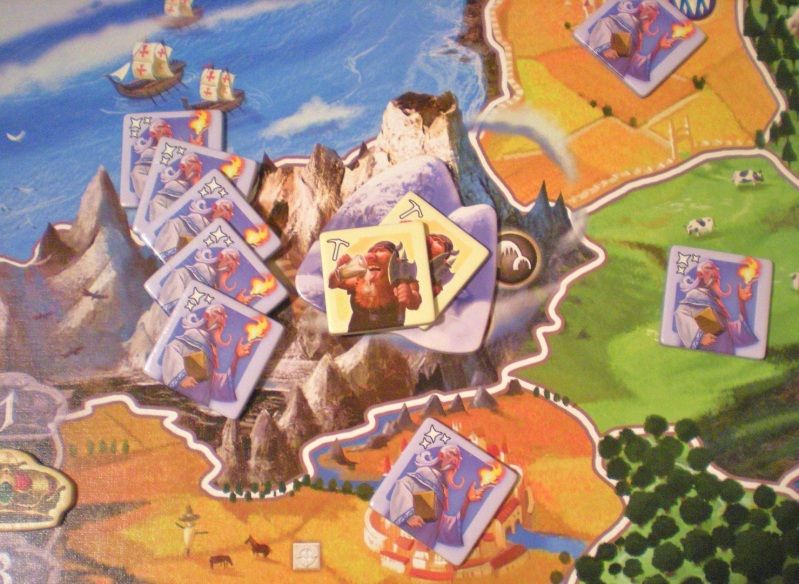
The wizards need 5 tokens to defeat the
2 dwarves defending the mountain - just enough!
The variability of the racial and power combinations is Small World's greatest strength.  I mean really, a game about taking over cardboard tokens with 1 extra cardboard token, ad nauseum, would quickly get old.  Instead, you'll need to leverage the particular traits of race/powers as they become available.  When some one selects a combination, it is replaced by another random pair from the stacks.  This mechanic leads to a great deal of replayability, not to mention some ironic pairings such as stout elves, flying humans, heroic ratmen, and commando halflings.  All of these traits provide different bonuses.  You might earn more points by owning specific terrain, or be able to attack with less tokens under certain conditions, or build better defenses, to name but a few.

Some gamers may balk at the direct confrontation; but again, your race's characteristics and special powers will encourage you to go after specific land targets or situations, not necessarily individual players.  This means that the belligerency is not as personalized.  Sure, there are times you'll want to target another to check his growing empire; but by the time you do, he's already earned his points for those lands, therefore it's not a central strategy.  So unless you just want to be a jerk or you like ocean views, you're not going to conquer any old territory willy-nilly.  Instead, you're going to take advantage of your race's particular capabilities and invade areas that will maximize your points in doing so.  The most efficient engine will win; there's very little room for any meta-game.  Also, despite the contentious nature, there is no player elimination.  First off, you will generally loose only one race token each time another player takes over one of your territories.  Anyone else so ingloriously evicted you simply redeploy to other territories after the current player's turn.  Second of all, if you do become too weak (and you will eventually, by design) you simply put that floundering race in decline and grab another.

The race tokens.

The spite factor is also softened by the humorous feel of the game's design and illustrations.  A variety of familiar, and not-so-familiar, fantasy creatures are artfully rendered to appeal to non-geeks.  At the same time, they're not so irreverently done so as to be completely offensive to what fans of Lord of the Rings have come to know and love.  It's difficult to get too upset when those prancing elves, ale-swilling dwarves, and cowboy skeletons march through your lands.  Besides, you can just liberate them again with your bikini-clad amazons or your sorcerers that look like Vincent Price.

Some combos make sense (top).
Others? Eh, not so much (bottom)!
Small World does include one wee element of chance.  On the final invasion of each turn, you often lack the required +1 number of tokens needed to conquer a territory.  In that case, you may roll the reinforcement die and add the number of pips to your leftover tokens.  If the two together are enough to successfully invade, then you get that space at a bargain rate.  Individual turns are relatively quick, although there will be some downtime in 4-5 player games.  A full game will go no more than 8-10 rounds, providing a nice end-goal that is in sight.  Overall, our own sessions run a tad over an hour with five players.  It also scales very well between 2-5 people because of the different board configurations and the fact that victory points are kept hidden.  However, we tend to prefer the chaos generated by 3 or more.  There are several small expansions to this base game, plus a very recent Small World Underground release that can be played alone or in conjunction with the original game.  So if you're really into that, you can keep adding variety until your heart's content or your wallet's empty.

Okay, I'll Shut-Up Now:

Personally, I rate Small World a 9 on the BoardGameGeek scale (Excellent game. Always want to play it.).  It is light, easy to learn, fun to play, pretty to look at, changes every time, and provides a variety of useful choices - which all adds up to an extremely accessible title that kids, casual gamers, and hobby enthusiasts can all enjoy together.

February 22, 2012

Board Game Review: Warlords of Europe

Warlords of Europe (Conquest Gaming/Kyle Battle, Ken Griffin and Russ Rupe, 2010)
2-4 players / 12 + / 2-4 hours

"Okay, dad, say good-bye to your castle in Germany!  My army is rolling in!"

"Ha, you don't frighten me Danish pig-dogs!"

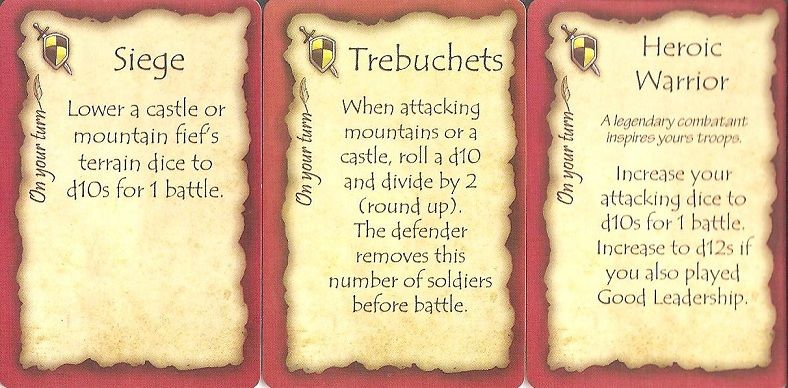
"Yeah, right.  I play 'Greek Fire' first to kill off four of your guys."

"Go and boil your bottom, son of a silly person, you and all your silly knnnnnnnnnn-iguts!"

"Whatever. Then I play 'Heroic Leadership' to give me ten-sided dice."

"I blow my nose at you, empty-headed animal food-trough wiper!"

"Um, okay, yeah, then I play 'Seige' which reduces your rolls to the ten-sided, also."

"Ah, I don't want to talk to you no more!  Now go away or I shall taunt you a second time!"

"Too late, dad..."

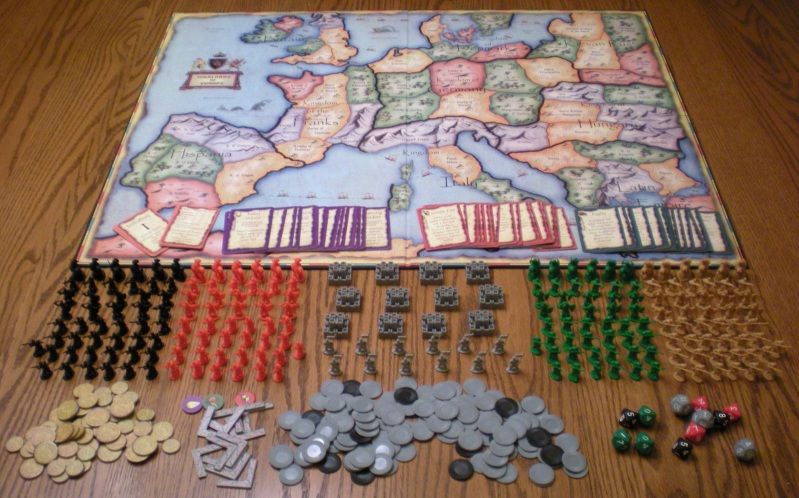
Lots to play with.
What You Get:

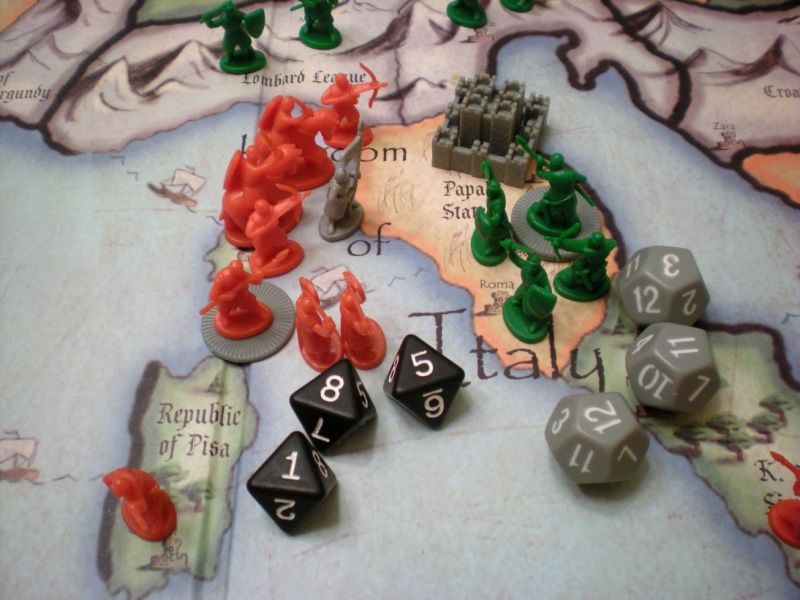
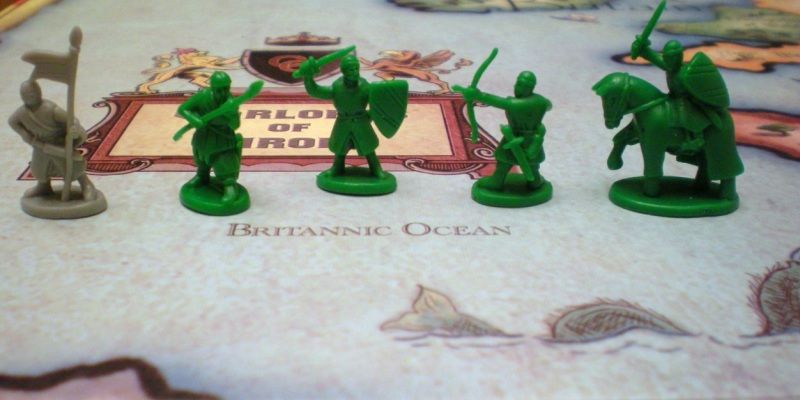
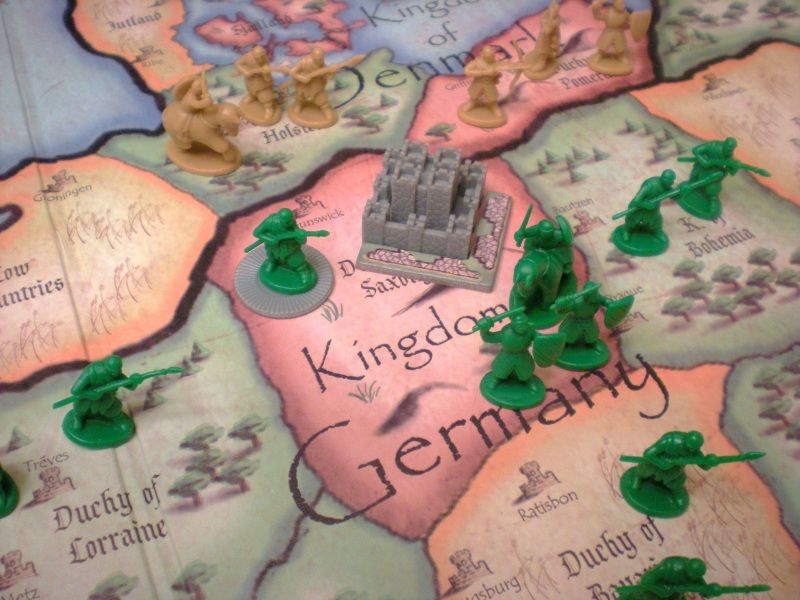
What every kid wants:  toys!  Even (or maybe especially) "kids at heart" will drool over the components in this box, namely the 200+ detailed, plastic army and castle pieces.  I'm not afraid to admit it!  The castles are basic and stout, while the spearmen, swordsmen, archers, knights, and warlords are all finely rendered.  One minor issue is that the warlords are all grey instead of each player owning a few in their own color.  As they are captured, you really need to remember which belonged to whom since there are ways to get them back.  There are three decks of cards, under-sized and sturdy, that provide some big bonuses and great thematic flavor.  The cardboard coins and tokens are thick enough to handle and endure.  There is a baggie of mini-poker chips which can be stacked under some units to represent greater numbers.  The board is solid, stylistically antique-ish, and not too "busy."  There are some small issues in distinguishing a few borders, here and there, and you will experience a good deal of territory over-crowding - unfortunately an attribute endemic to most dudes-on-a-map games not produce by Eagle.  Then throwing caution to the wind, the designers toss out the commonplace six-sided die and instead include a gaggle of d8s, d10s, and d12s.  There's nothing particularly special about these dice in themselves, but just for the refreshing change in replacing the overused standards!

The Quick Rundown:

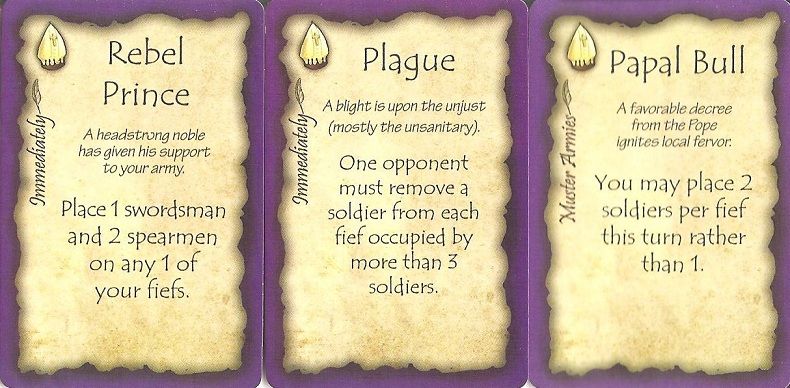
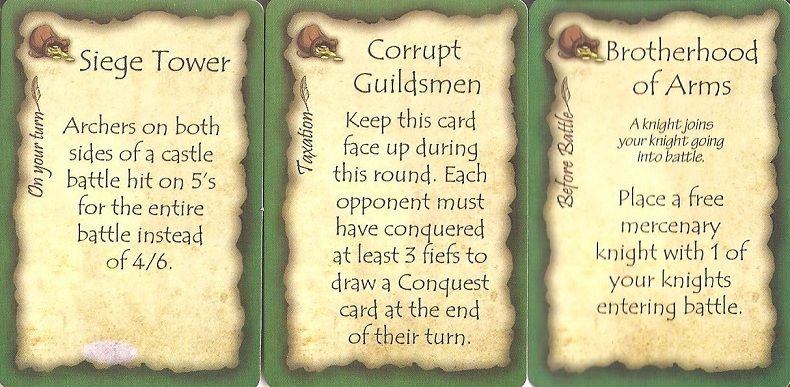
Warlords of Europe takes mechanics that all conquest wargamers are familiar with from other titles, and mixes in a few tweaks for a unique experience.  Its closest cousin is probably Ikusa (aka Samurai Swords of the 1980s MB GameMaster Series).  As a medieval lord, all players begin with a couple of fiefs, a castle, and a small army with the goal of expanding territory and capturing a majority of Europe's castles.  More lands and castles yield more money - with extra bonuses in consolidating all the fiefs within larger kingdoms.  That money is used mostly to build up your army or hire mercenaries (which are the same units, but you only get to keep them for one turn).  The units available include archers (who fire separately in combat as ranged units) and then spearmen, swordsmen, and formidable knights.  Warlords are also available in limited supply that, in addition to their combat value, act as generals who can move any number of units attached to them up to two territories.  Combat is determined by cross-referencing several tables based on combined arms, morale, initiative, terrain, weather, and leadership.  No, not really - you just throw some dice.  But the refreshing aspect here is the three types of dice.  Which ones you roll is not based upon the units involved, but rather the terrain.  Normally, both sides will resort to the d8.  However, if you are defending in the forest or in a partially built castle, you get d10s; if you're holed up in the mountains or in a completed castle, you can break out the intimidating d12s.  Better units require lower numbers to score hits.  There is yet another crucial component that really defines this game: cards.  Each card in the three different decks provides some pretty significant bonuses that can really make or break your strategy.  Conquest cards are earned once per round as long as you've conquered at least one fief.  All players receive a Papal card every turn as long as they're in good standing with the Pope (which is almost always).  Finally, merchant cards are available for purchase.  You will acquire a good number of these over the course of the game and their effective use cannot be stressed and appreciated enough.

T for Teens:

I may sound like a broken record before I finish up with our collection of this genre, but the same principle applies here: my kids (boys and girls) really have a deep interest in dudes-on-a-map, conquest games, yet struggle with strategic decision-making and also get quite restless while waiting on their next turn.  But it goes back to the toys.  The little figures seem to be a natural attraction for kids (my kiddo gamers are ages 9 and 10).  I can remember playing similar games back in junior and senior high for the sheer, unquantifiable awesomeness of it all.  And the publication and sales of such games proves there is a market among adults in the hobby.  Maybe it's because we start young?  I mean, even as we're playing, my 4-year old daughter will grab my extra army pieces and head off to the other end of the table to feed them, and dress them, and drop them off at daycare.  Or, um, should that be knightcare...?

More to see than just the d6!

My kids really get into the Middle Ages setting.  I suspect most other children will, too.  They delight in battling with swords, storming castles, and sending forth their knighted hero to rescue the princess...only in this case, it's a warlord, which actually is kind of awkward.  No matter.  I share their enthusiasm for the theme.  Playing the GameMaster series as teenagers, my friends and I dreamed that Milton Bradley would give us the opportunity to use our strategic wits, honed on the fields of ancient Rome and medieval Japan, in the fiefs of Western Christendom.  Sadly that was never the case.  But this oversight has now been gloriously corrected by Larry Davis' spiritual successors at Conquest Gaming, LLC.

Outside of wargamers, downtime and game length are probably the biggest turn-offs in this genre.  Warlords has two mechanics that seem to address both problems, yet do not alleviate them completely.  Though honestly, I'm not sure that's possible for a game of this nature without removing its heart and soul.  It would be unfair to ask for evangelical titles to convert the light hobby or Euro gamer to the wargaming faith.  So how does its mechanics connect with kids?

To alleviate downtime, a number of actions are executed simultaneously (or nearly so) during a Group Phase.  These brief actions are resolved in fairly quick succession and include a victory check, taking a Papal card, levying taxes, mustering and deploying units, building castles, assigning initiative, and purchasing Merchant cards.  These are settled in a particular order based on initiative, which changes each round, and anyone may play cards during these action phases when indicated on the card.  It is a helpful mechanic to break up all of the logistics, shorten the focus on individual campaigning, and keep players involved in a more frequent rotation.  Another added benefit to concurrent mustering and deployment is that all players have a chance to replaces losses before the next campaign season begins.  When the campaigning does start, you will be waiting while the other players announce their movement, resolve battles (which could involve you), and finally maneuver reserves.  There is downtime.

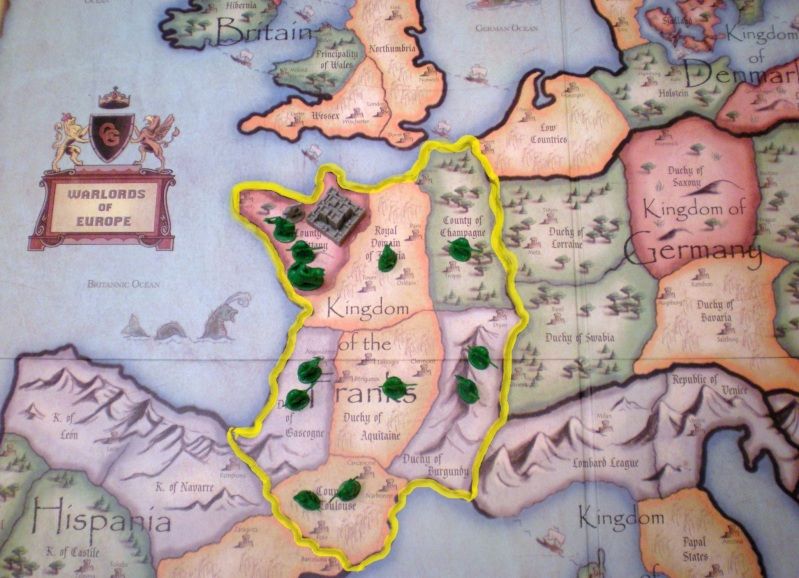
While still an afternoon affair for 3-4 player games, the victory condition mechanic and scenario options go a long way to help reduce overall game length.  Rather than conquering every last square inch of land or completely eliminating all enemies, your goal is to capture and hold a majority of castles (all of them in a 2-player game).  That is still no easy task - which accounts for the games 2-4 hour span.  Yet it provides a finite goal in what might otherwise turn into an exhaustive marathon of give and take.  This measurable victory condition will also guide players' strategy and is conducive to streamlined game play.  Castles are extremely important in this game, which makes sense given their political, military, economic, and social dominance of the times.  You must own one in any given kingdom in order to collect taxes from its fiefs.  If you control a majority, or all, of the fiefs in a kingdom, you are awarded bonuses in the form of extra taxes and free levees.  Losing your last castle means you no longer collect money, nor can you hire knights - and that's a tough slog.  On another note, suggested scenarios scale the playable map area to a smaller number of kingdoms, eliminating the slow and boring build-up and forcing players into early confrontation.

Six to seven fiefs comprise one kingdom (highlighted in yellow).
Own them all and reap the rewards.
If castles are the heart of the game, then its soul lies in the cards.  Each card either provides you with a sweet benefit, allows you to break a rule, or cripples an opposing player of your choice.  In addition to providing fun, historical flavor, the cards offer uncertainty, secrecy, hope, healing, and revenge!  This all adds up to excitement in our book, but I imagine the added randomness could be off-putting for others, especially when the dice can already bless or curse your plans.  Mechanically speaking, these cards serve as a minor leveling device where a run-away leader problem is otherwise an issue.  As one player edges ahead in fiefs and castles, it is quite easy to exploit her extra gold and quickly surge forward, even seeming unstoppable.  But then you draw that card, or more, allowing you to infect her with the plague, or steal some gold, or roll better dice for a critical assault on one of her strategic castles.  You're position is not always as secure, or hopeless, as it may appear.

An unfinished castle.

There is one quirky aspect that can significantly affect game play.  On your first turn, your only goal is to successfully consolidate the 6-7 fiefs of your starting kingdom.  From your 2 start territories, you'll invade the other lands and fight the peasants there: 1 in mountain fiefs, 2 in forest fiefs, and 3 in plains and farming fiefs.  Now most of the kingdoms are fairly balanced and the success rate for accomplishing this task is very high.  However, while it won't occur every game, it will eventually happen that a player will fail to consolidate his kingdom and, therefore, miss out on the early bonus gold and spearmen.  It may sound minor, but that person will then be disadvantaged right from the start and must be especially diligent to reach equal footing.

Okay I'll Shut-Up Now:

In the end, I personally give Warlords of Europe an 8 on the Board Game Geek scale (Very good game.  I like to play.  Probably I'll suggest it and will never turn down a game).  It would not be the first wargame I recommend introducing to your children, especially younger than junior high.  But kids, like adults, will be hard pressed to resist its sweeping historical narrative and epic theme.  While most mechanics will be familiar to even moderate wargamers, top-notch components and fresh tweaks create a fun medieval experience.  Simply stated, if enjoy conquest games you must have this title.


Card examples (from top): Conquest, Papal, Merchant