September 14, 2011

Card Game Review: Mag Blast

Mag Blast (Fantasy Flight/Christian and Anders Petersen, 2006 [3rd Ed.])
2-8 Players / 10+ / 20 minutes

The situation was bleak.  My scattered fleet vainly tried to regroup, but I sighted enemy targets in all sectors.  I had no ships in the Blue or Green quadrants.  My crippled command ship's alarms blared incessantly, warning of impending doom.

"All power to shields," I barked.

"Admiral," meekly replied one of the few surviving crewman, "we don't have shields."

In disbelief, I growled, "What?! Just what kind of spaceship is this? I want to speak to Gene Roddenberry."

"Well, sir, that might be arranged here in just one second."

"Huh?!"
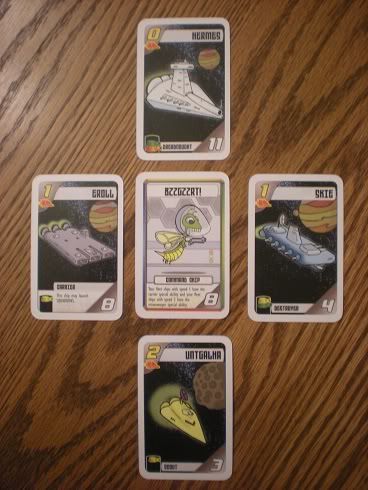
A starting fleet.
"INCOMING!!!"

What You Get:

Surprise!...Cards!  There are 10 races with varying abilities (represented as command ship cards), 54 fleet ship cards (of various classes and configurations), and 101 action cards.  Fantasy Flight's usual reputation for quality holds true to form here.  They're sturdier than the average poker cards and linen-textured.  John Kovalic's cartoonish art is appropriate for the light-hearted, chaotic theme and will delight sci-fi fans with its satirical homage to the genre.

The Quick Rundown:

Your goal in Mag Blast is to blow your opponents out of the stars!  There are no victory points in this frantic free-for-all.  If your command ship is destroyed, you're eliminated from the game.  It's as simple as it is brutal.  However, you have a fleet of ships divided among four sectors around your command ship for protection.  Before you can target an enemy command ship, you must empty at least one of his sectors of any fleet ships and then you can start pounding it with one of your own ships through that corresponding sector.  You begin the game with only one random fleet ship in each quadrant and do the best you can with the action cards at hand.  Each fleet ship is rated for strength (hit points), maneuverability (movement points), and weaponry (type of gun[s] it can fire) - plus a couple types have a special ability.  A turn consists of first discarding any action cards you don't want, then drawing until you have 5 cards in hand, then discarding certain cards for an extra fleet ship (if possible), then maneuvering your starships between sectors, and finally playing any action cards you wish.  Action cards allow you to blast the enemy (once per turn, per ship) and also provide various other combat results such as direct hits that can catastrophically destroy an enemy vessel or capture it, etc.  There are also fighter and bomber squadrons you can launch to inflict more damage if you have a carrier.  You can even play action cards defensively to avoid damage.
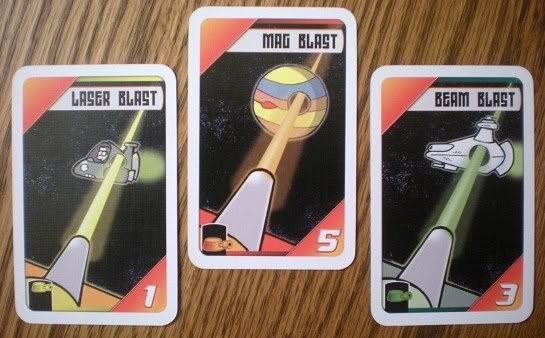
Hence the game's name.
E for Everyone:

This game puts "confrontational" on the map.  I mean when the goal of a game is to destroy your opponent ruthlessly and as fast as possible, we are dealing with a special category of interaction.  So does that make Mag Blast suitable to play with kids, who by nature are more prone to react emotionally to this particular gaming characteristic?  From our family's experience, I would argue not only is it suitable, but it can provide some great times.  I say that for several reasons.

First, it is simple to learn and play.  While opponents may be bashing in your bulkheads, the rules at least are not bashing you over your own head.  The only part of gameplay that may take a few rounds to keep clear is between the three types of guns and the four different sectors.  Fleet ships can only fire blasts into their corresponding sectors and may only fire the type of blast(s) that their rating allows - laser, beam, or mag (dealing 1, 3, and 5 points damage respectively).  The four sectors are color coded blue, green, yellow, and red while the three blasts are similarly color coded yellow, green, and orange.  My kids were confusing the limitations of color sectors vs. color blasts and mixing them up.  After a full game, it should not be an issue.  The rest of gameplay is well structured and the special action cards have clear instructions regarding their abilities.
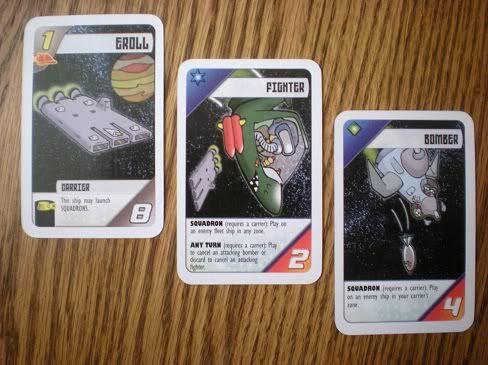
Carriers can launch fighters and bombers.

Second, it is light-hearted.  Sure, the sci-fi satire pretty much sails right over my kids' heads (except for a bit of Star Wars, perhaps), but the cartoony and humorous art keeps any tension that the game generates from being stressful.  For a game of cutthroat battle, it just doesn't seem vicious.  And the oft-maligned rule of having to make a "sound effect" as you play a blast card (or miss) proves that this tongue-in-cheek game doesn't take itself too seriously.  "Dude, did you just say 'pa-choo, pa-choo,' when you shot my cruiser?"  I mean come on, it's hard to really take that personal.

Third, it's almost always quick.  It is not unheard of for a player to be sucked into the cold vacuum of space before they even get a turn!  We have a gentleman's agreement in our house to give everyone at least one turn.  While early elimination can be a major drawback with other games, it's not as critical to us in Mag Blast because we usually play a few games at a sitting.  Now, if you're unfortunately vaporized that quickly in all of those games in one sitting, well then, I would contend the issue is with your gaming group and not the game!

Finally, the variety of cards and randomness provide for unique games every time you play.  While I don't necessarily recommend playing this ten times in a row, it will not grow stale for periodic plays.  In some games, all I can do is fire away at the enemy with conventional blast cards.  Other times, I'm able to draw good combinations of direct hit cards to really deal damage or change up the situation.  Sometimes you get plenty of reinforcements to replace losses and other times you're scrambling to shore up holes in your defenses.
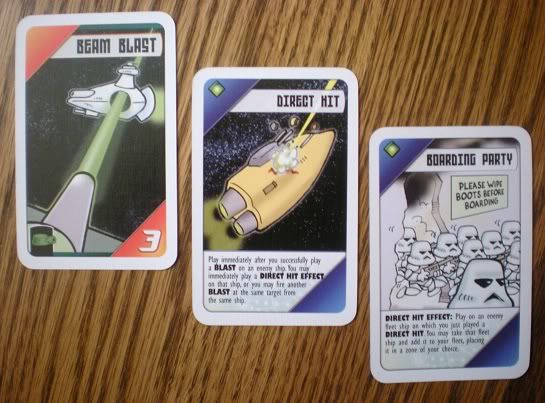
Playing a direct hit and an effect with a blast card rocks!
Now, to be honest, this will not be a "go-to" title for serious gamers nor one that will motivate a gathering together.  Hardcore strategists will keep their distance like Klingons avoid Tribbles.  I also don't see it as a casual party game since the sci-fi geek theme will be lost on mainstream society.  It is what it is.  There is next to no strategy; luck will drive your battles; and the chaos factor is off the chain (especially the more players you have).  I could say there is a balancing act with the maneuver action in moving ships around to maximize firepower or protection by sector.  And there could be an interesting, diplomatic meta game with numerous players creating shifting, advantageous alliances.  But I'd be over-stretching its strategic reach. 

Okay I'll Shut Up Now:

In the end, I give Mag Blast an 8 on the Geek scale (Very good game.  I like to play.  Probably I'll suggest it and will never turn down a game.).  Even though you'll delight in knocking out your child's ships like bulls-eyeing womp rats in your T-16 back home, she'll relish in returning the cruel favor.  This quick, light, and simple romp creates quite the many surprising narratives for its breadth and price.  Whether you need to fill some time or want a break from the deep strategy slugfests, Mag Blast is a good choice as a thematic and chaotic yarn...I just wish it had deflector shields!

September 13, 2011

Gaming with Kids: Luck


Baby needs a new pair of shoes!  Now as it happens in a house with seven kids, that statement is often true at any given moment.  Okay, so we don't gamble for the funds to purchase said footwear.  But I've never minded a bit of gambling in board games.  Luck is a fascinating gaming characteristic that I never tire of reading about on forums, blogs, and other venues.  To many hardcore gamers, it is a 4-letter word to be avoided like a 24-hour TVLand Brady Bunch marathon.  Of course, there are many people who like the Brady Bunch (*raises hand*), and so to other gamers, luck is not only accepted as a natural element to games of all kind, but indeed preferred over those all-information-available think-fests.

Many others have covered this topic in a far more thoughtful manner than I could.  I'll give just a couple thoughts on the overall concept of randomness.  Otherwise, I'll just opine on this characteristic in how it relates to playing games with kids.  To cut to the chase, randomness in some form is an extremely beneficial mechanic in playing hobby games with your kids.  To what degree may be a matter of opinion and situation.  It depends first on the child's age and then also on his/her experience with board gaming.  Beyond that, it depends on your child's natural ability to grasp this particular hobby.  Realistically, people of all ages have various inclinations to hobbies, sports, activities, likes, etc.  We're all wired differently.  You know your own kid better than anyone.

However, even if you have a board gaming prodigy on your hands, it's extremely difficult to trump experience and mental maturity.  And so in that sense, without being patronizing or condescending, luck becomes an essential equalizer.  Especially if you're of the philosophy that taking it easy on your children in gaming does more harm than good, you will want high elements of luck in the games you play to give your kids more of a chance.  Even if you play fast and loose with game rules and mechanics, it is still helpful to have a measure of random elements.  Yes, kids can learn a lot in defeat, as we all do, but being on the receiving end of beatdowns time and time again will seriously erode their future interest in this hobby.  And that is counter-productive to the whole point of getting them involved early on in their lives.

Many gamers bemoan luck because it will mess up their best laid plans.  It can be frustrating to formulate a good strategy and build towards implementing it only to be thwarted because you can't draw the right card or roll the right number.  Then on the other end of the spectrum, a good number of gamers mock the randomness factor because players can stumble into a win, including themselves.  If on the losing end, this can be a point of resentment forever souring a view of the game.  But even if the lucky one, gamers can feel cheated by the "cheap" victory.  Either way, it is viewed as unearned, tainted, or likened to the asterisk that needs placed by some baseball records in the wake of steroid usage.

Most kids do not generally think in the same terms.  A win is a win and, to them, they will have earned it to some degree.  This is because the vast majority of hobby games are not entirely luck-driven, like say Candyland or Sorry.  They are still exerting some control over the game.  Sure, my kids recognize when "bad luck" strikes.  But they would never know that "dice hate me," except that I've yelled it numerous times!  They realize that randomness serves as a leveling device.  Especially in the absence of a game where they can gang up on me, they appreciate the fact that the unknown keeps them in the mix.  I also appreciate that as it allows me a balanced opportunity of teaching strategy while not completely easing up on them, yet still keeping them competitive.

We have some enjoyable games all along the randomness spectrum that have worked well for us.  Mag Blast is probably the most chaotic luckfest we own, but still fun.  Area control war games like Axis & Allies provide a strong emphasis on strategy which is heavily influenced by the die rolls.  Then we have games like Small World on the other end which are much more strategic in mechanics, but with some minor doses of randomness to keep you on your toes.
In the end, I would contend that random elements are essential to kids learning strategy games.  It keeps them competitive while they develop their critical thinking skills and hone their analytical abilities.  Plus, it teaches them to adapt to changing game situations - a useful lesson.  After all, life is what happens around us when we're making other plans, right?  The next surprise is always just around the corner.  Plans rarely go...well, as planned.  Some of the greatest battles in history turned on pure, unadulterated, blind (or rotten) luck.  Mega pop stars are accidentally discovered.  Major sporting events are won by freak ball bounces.  Lives are changed by natural disasters, world economies, the lottery, and other things we have no control over.

I argue that a game that does not include random elements is unrealistic.  Pure strategy games may be good learning tools.  Analyzing puzzle games where all information is accessible strengthens the gray matter.  But games that teach you how to manage chaos, adapt to change, confront the unknown, and deal with the monkey wrenches thrown into the machinery teach kids more practical things - because that's life.  Preparing for that randomness then becomes a strategy in and of itself.  Because its not really about gambling for baby's new pair of shoes; but instead preparing for when the need comes up...whenever that might be.

September 12, 2011

Gaming Report: Red November, Mag Blast

A packed weekend in which the kids had plenty going on, but we still made a little time for a couple board games.  I rolled out Red November for the first time with the kids.  I'm pretty sure I corrected the rules we missed when the brother-in-law and I broke the shrink on it last weekend.  It was indeed a frantic affair with one of the kids even about to abandon ship, but his path was blocked and we were able to avert the immediate disaster that was motivating his cowardice!  In the end we survived by the skin of our gnomish noses: one gnome remaining with 8 minutes left, trapped in a room with all hatches blocked, one tick away from both the oxygen pumps and the reactor completely failing, and three event cards to draw.  FUN TIMES!  The kids struggled a bit with the mechanics and the confusion, but that was expected for their first play.  Still, they had a good time.  As our first cooperative game, it was cool to see them think out the chaos management.  It was encouraging to watch as they analyzed which gnome had the best opportunity to fix various problems based on their location and items in hand.  It was also disconcerting and humbling to see them ready to abandon their loved ones without hesitation!  Ah, board gaming.


Then on to something decidedly not cooperative: Mag Blast.  We really enjoy this game.  Some decry it as an aimless filler, or overly light, or frustratingly random.  We like it because of all of those points.  It's humorous and quick.  And while by design it is super spiteful (you're blasting opposing vessels out of the stars!), it's usually quick enough to negate the drawbacks of player elimination.  The kids (okay, me too) really get a kick out of making the blast noises.  And they generally gang up on me.  Ah, board gaming.

September 08, 2011

Board Game Review: Magnifico

Magnifico (Dust Games/Spartaco Albertarelli and Angelo Zucca, 2008)
3-5 Players / 14+  / 120 minutes

1499 A.D.  The foreboding Castle of Milano ominously stood sentry over the north Italian countryside.  Many thought it impregnable as its monstrous walls rose to the sky, reinforced by massive towers at every corner.  Its lord boasted it would never fall - even against 100,000 men.  But in a rare moment that I would be foolish not to seize, the enemy emptied the castle garrison off all but eight infantry units.  So I would put that declaration to the test!  Gathering my armies from the surrounding lands, I march my legions of pikemen upon the fortress and begin the assault with my...

...tanks?!

What You Get:
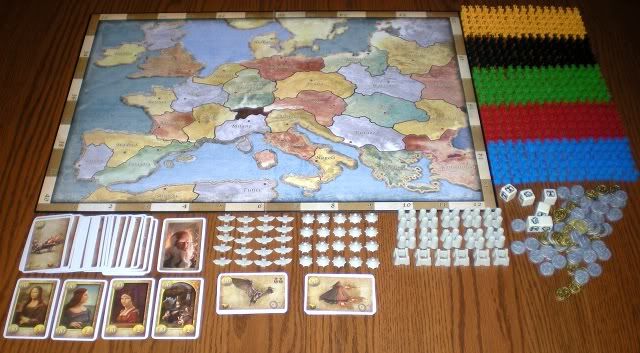
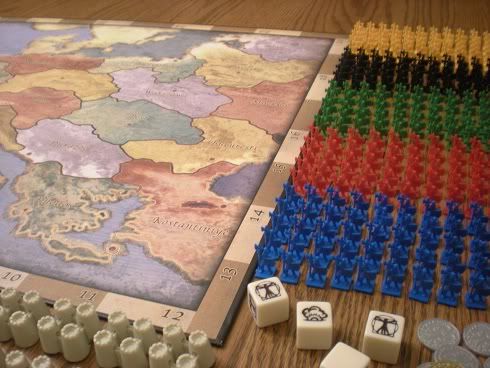
    Lots of plastic! The components are snazzy and well detailed, but a bit too small for a "dudes on a map" game, which will be fiddly by definition.  Da Vinci's tanks all look like flying saucers and his planes look like hang gliders - but theming alternate history is not an exact science.  The infantry are all halberd-bearing Swiss mercenary types of the Pope's Guard variety.  No doubt after being mowed down by Renaissance tanks, they found employment in Papal service far safer.  The mounted board is both practical and gorgeous.  The cards are sturdy, linen-textured, and with appropriately baroque artwork for the time period's theme. I do wish Dust Games had provided a reference sheet describing the cards and their iconography, though.  It is especially confusing for kids. It is now published by Fantasy Flight.

    Legions of plastic bits!
     The Quick Rundown:

    Magnifico is Ameritrash at is core with some Euro game elements.  You start with one territory, two dudes, a castle, and a pile of coins.  What makes this "dudes on a map" game unique is that your money is used to bid for certain project cards (all based on Leonardo da Vinci's inventions) which determine turn order, provide a variety of combat advantages, and give victory points.  The usual elements of any war game are here with some unique twists.  It costs money to invade other territories and wage war, plus you are limited to the number of times you can attack in one round.  Grunts are free.  You can only buy tanks and planes if you have one of the appropriate project cards.  Attacker gets to roll first and remove casualties before the defender can fight back.  However, you can also kill your own men while rolling (which I guess could simulate defensive return fire or perhaps friendly fire?).  Tanks are especially fearsome as each one rolls a handful of dice and can wipe out half a dozen infantry each time - but if you roll really poorly, a major malfunction will destroy your entire army!  Additionally, only infantry can be taken as casualties (with a few exceptions) and when all your infantry are dead, the enemy captures any remaining tanks and planes.  The other major Euro element are victory points.  You earn these by owning the most castles, conquering the most territories, building the most projects, and displaying Renaissance-era, pin-up models in your gym locker at the country club.  After expanding and fighting and waxing and waning, eventually some one will earn enough points to be declared Magnifico, which comes with a funny hat and your own personal Swiss guard sans Popemobile.

    T for Teens:

    Generally, I pay little attention to the age range on the box.  My kids get into a number of games even though they may be younger than that suggested.  However, with Magnifico I think that 14+ is accurate.  If this were the first war game introduced to my kids, I don't think they would have had as many issues.  However, there are enough twists in here on old, familiar mechanics that they stumble through play and constantly ask about rule clarifications.  The game is probably better suited for older children, even probably teenagers.  With that said, I think some of the mechanics that threw off my children will probably also turn off some regular strategy gamers

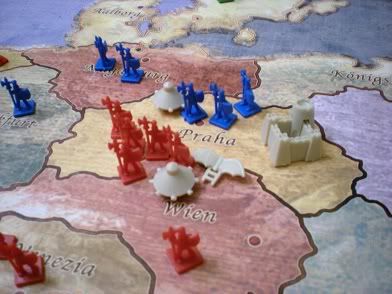
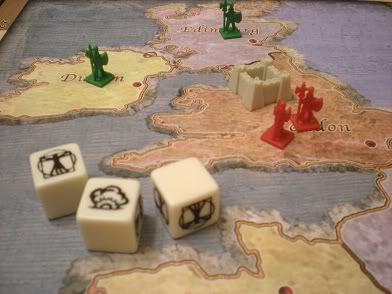
    An assault begins.
    First off, tanks are powerful.  Really powerful.  My kids think they're over-powered.  There are enough tank project cards in play for everyone to have one tank card.  You can only own one and you need it to build them (same with planes).  Which specific card you have will determine how many dice each of your tanks roll in combat and how many hits you score with a successful roll.  When a tank rolls all of its dice and does not roll any explosion symbols, that is considered a complete success and you score all the hits indicated on your card, generally 4-6 (plus additional hits for any tank upgrade cards you can bid for and purchase separately).  That's a lot of damage inflicted on the defender with just one tank, especially when you remember those defenders never get to even fire back!  However, this advantage is tempered by several things.  First, if you roll just 1 explosion, you only score half the kills allowed per your tank card and any upgrades.  If you roll 2 explosions, you score 0 hits.  And if you should be unlucky enough to roll 3 explosions (of which I often am), you're entire army is wiped out in a major malfunction - the "Mother of all Backfires," I suppose!  You can only build one tank per turn.  And if you leave yourself vulnerable to counter-attack, it is possible your tanks will be captured by the enemy and then turned against you!

    Beware the explosions...
    The other major issue my kids have with the game is that it is very difficult to catch-up if you fall behind.  Money and victory points are awarded based on owning territories, castles, and projects.  It is difficult to acquire those if you don't have money; and it is difficult to get money if you don't acquire those.  Fall too far behind and you don't have money to bid for projects which will generally better your combat abilities.  You can turtle and build up your castle defenses making it extremely difficult to lose a territory or two, but where's the fun in that?  You can't count on your infantry; they may be free, but you only get one per territory and they're weak beyond about round three.  You really need tanks to be effective both on offense and even in defending strong castles.  Otherwise, you're sitting and waiting for an opportunity to take advantage of two stronger neighbors weakening one or each other.  By then, it can be too late to catch-up in victory points.  The three attacks per turn rule is generally not enough to slow down the leader.

    The castle defenses can also pose grumbling among my kids.  The only real plausible defense against tanks is a castle, which then can swing the advantage to the other extreme.  A castle with four towers reduces all infantry and individual tank hits by five, making assaults upon these fortresses a dicey affair.  Many will think this too great a defensive advantage and encourages turtling.  But turtling earns you no points.  There are ways to increase your odds against these beastly cities.  Planes ignore castle defenses - but there is a risk they will be destroyed in the attack.  You can get the paratrooper project card which gives you're entire army a chance to ignore castle defenses - but you have to win one in an auction, pay to play it, and then roll successfully to even employ it in battle.  So mostly it comes down again to the backbone of the game: tanks.  The best way we've found to assault even the strongest castles is to build as many tank upgrades as possible in order to increase the number of hits each tank can score.  And then bring lots of them.

    I personally like Magnifico.  The game gives a fresh twist to almost all the tried and true mechanics you see with "dudes on a map" games - but you may need to get used to them.  Components are better than average.  The theme is original and well implemented.  Combat is unique.  You must save money to wage war.  The project bidding ensures that games vary from play to play.  Planning out how best to use your menacing tanks is challenging.  The tight economy, attack limitations, and unforgivingly quick combat mechanics keep turns relatively short.  The victory point system prevents needless all-day slugfests.

    Okay, I'll Shut Up Now:

    In the end, I give Magnifico an 8 on the Geek scale (Very good game.  I like to play.  Probably I'll suggest it and will never turn down a game.).  It is not the best choice for younger kids, though.  My kids are willing to play it and it will probably grow on them over time.  But the brutal and sometimes bizarre combat results, along with the "weak get weaker tendency," leaves them preferring other titles.  For teens and adults, you may enjoy this one for what it is:  an original and lighter war game with unique twists on the genre.  If you prefer more old-school, traditional strategy games, this one may not be for you.

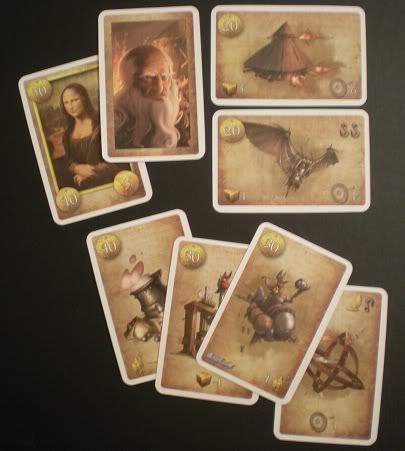
    The artwork is fantastic.

    September 07, 2011

    Gaming with Kids: Strategy


    I'm pretty sure all hobby gamers have a little bit of Napoleon in them - and not as in a 'Napoleon Complex' (though that could explain many an attraction to board gaming!).  No, rather there is something about studying a board, examining options, formulating a course of action, and then executing it just as planned - while ruthlessly devouring your enemy - that is oddly satisfying.  In fact, from the gaming forums, blogs, and review sites that I follow, many gamers so love this aspect of gaming that they truly disdain any mechanic that employs even the rudiments of luck that could sabotage their best laid plans!  That’s another topic to examine later.

    Of all hobby gaming's characteristics I've found this one the most problematic in gaming with my own kids.  First off, to be clear, my kids really dig strategy.  In the more complex games, they will noticeably (and agonizingly) take longer turns in order to process all the options.  When we have to stop and leave a game set-up until returning the next day, I will invariably find them sitting at the table later by themselves studying the situation.  And quite possibly their favorite thing in all of gaming is engineering the most efficient means of ganging up on their old man - the sneaky little twerps!  In this regard, I would argue that children can be different than the non-gaming crowd.  If introducing a Euro game to non-gamers in my extended family, I would pick the simplest and most straight-forward game in terms of rules, mechanics, and strategy.  With my kids, I'm not as concerned with being quite so discerning, even busting out the war games.

    I say problematic because, although they enjoy strategy, they often fail to look ahead enough turns in order to completely analyze all choices.  This also may be natural for adults (specifically non-gamers), but it’s not necessarily as simple as that with kids.  Children are good at examining the avenues before them, choosing one based on the situation at hand, and then properly planning what needs implemented to accomplish that one goal.  That's the basis of strategy.  However, sometimes they will choose one path out of many options under the assumption that it will operate within a vacuum, rather than understanding entirely how their decision impacts the cause and effect relationship among all of the paths together.  They fail to see the forest because of their tree.

    In our first plays of Dominion, for example, they realized early on that concentrating on Estate cards too soon would mean clogged and worthless hands.  Good thinking!  Knowing that they had to string card combos together, they would concentrate on going after the +card(s) and +action(s).  That’s on the right track!  But of course after drawing a good amount of Treasure cards with their +card/+action combos, they would have no +buys with which to take advantage of the extra money in hand.  Or on another front, perhaps the attack cards were so attractive they'd get an imbalance of Moats with which to improve the odds of protecting themselves against the attacks of others.  With my kids, it is less about formulating a good plan and more about the need to understand how other nuances affect their strategic choices.

    My kids love war games.  They delight in pushing little plastic cannon fodder around ancient maps and chucking truck loads of dice.  Sound effects are mandatory.  And war games are rich in strategy.  It is not uncommon for them to fully explore one strategic option while neglecting another.  It can be as straight-forward as building up to attack in one area while ignoring defense in another.  Or maybe more involved like failing to see the nuances of how other avenues can aid their offensive plans - the use of combined arms over masses of cheap infantry; shoring up a front with temporary diplomacy; attacking an area that better utilizes interior lines; or the use of small-scale economic warfare to erode their opponent's ability to fight.  While they certainly realize some of this, I think they often operate under a "one thing at a time" mentality without realizing that all of the nuances work together simultaneously - especially the long-term effects.

    So should you play deeper strategy games with your children?  By all means, yes!  Just keep in mind you'll need to teach them as you play - and plan accordingly.  As you realize what strategy they've adopted, look ahead for them and point out possible consequences.  Even hint at what you'll be doing so that they can learn to anticipate their opponents.  One of the fun things about gaming with my kids is that I'm not worried about winning, but simply engaging with them while they develop skills in logic, critical reasoning, and deduction.  On the other hand, don't play the game for them and give them every move.  That essentially leaves you playing against yourself which is not only sad, but renders moot any strategic planning in the fist place.  It also does very little, if anything, in allowing your kids to think for themselves.  They will even come to resent playing you if you don't give them a good dose of independence.  ‘Trial and error’ is just as good a teacher as your own experience - maybe better!

    Also, ease them into the heavier strategy games.  In that regard, the situation would be comparable to non-gamers, although many non-gamers would prefer not to move beyond even those introductory strategy games!  Just don't do what I did and start off with Axis & Allies!  The usual suspects of "gateway games" apply here.  One overlooked option that has done well in our house is Kingsburg.  This dice-based, worker placement/resource management game really requires a balance in developing your realm versus ensuring that you have enough soldiers to protect what you've built at the end of each year.  However, there are different ways to use your dice to achieve that balance as well as different game components you can use to manipulate those dice further.  The rules and mechanics are simple while still providing enough variety of strategic options without overwhelming you.

    With gradual experience and instruction, children can develop into keen strategists more so than the average adult non-gamer only interested in gaming for the social aspect, not the mental.  In no time at all, your child will be sweeping through your lands and smashing your little plastic bits to smithereens like the cunning, little Napoleon she is...

    September 05, 2011

    Gaming Report: Dominion, Red November

    Spent the weekend in Green Bay, WI, at my brother-in-law's and family.  He's a huge Pokemon player.  He and my nephew (10) play in a club, of sorts, up there every week at an awesome FLGS called Gnome Games.  They also play, and do very well, in tournaments up there.  Gnome Games supports pretty much all of the major gaming hobbies with open play, sponsored and official tournaments, and more, including Magic, L5R, board gaming, and miniatures.

    Anyway, last time they were down here in Illinois, I introduced him to Dominion thinking it'd be right up his alley - as a Pokemon veteran.  Success!  So I brought it with me this weekend, even though it was going to be a busy one.  We did get one play in - which he won.  And since my kids also like to play Pokemon (though we're much more casual), we joined them at their weekly gathering at Gnome Games.  I, of course, couldn't get out of there without a purchase, so we now have Red November in the collection.  That night, instead of a rematch of Dominion, my brother-in-law asked to try out the new game.  Rock on!  I'm sure he won't abandon Pokemon for the hobby gaming ship, but it looks like he'll be more than keen to jump into any genre of game when he's here, or we're there.  And that's a win.

    September 01, 2011

    Card Game Review: Citadels

    Fanning out the four remaining role cards, I sneak a glance at my tableau.  Seven districts.  One to go.  Then I observe that two of my opponents are in a similar situation, albeit with less gold.  Between my cash in hand and the two I will earn for my action that round, I have enough to lay down the Fortress - a nice card, but I'm more concerned with getting that 4 point bonus awarded to the first with eight districts.  Back to the character cards: the Magician, the King, the Bishop, and the Warlord.  Of course, the Assassin and the Thief are both gone already.  Perhaps one of them is that face down card in the center of the table?  Or did my rotten and conniving kids choose them, after my life and treasure again?  So, the Magician it is.  He plays third, hopefully getting me that 4 point bonus.  Plus I rarely pick him, so surely my scheming and scoundrel children will think I chose another?  The remaining roles go round the table.  The King calls out for the Assassin.  It's Brendon.  Of course.  He looks astutely around the group, everyone still and quiet (which, by the way is very rare at our house).  After pondering intently, he takes his action, builds his sixth district and, with evil glee, calls out, "I assassinate the Magician!"  Are you serious?!  ARRRGGGHHHH!!!

    The Vitals:
    • Publisher - Fantasy Flight (2006), with Dark City Expansion
    • Designer - Bruno Faidutti
    • Players - 2 to 7
    • Play Time - 20 to 60 minutes, per the box
    • Ages - 10 years and up
    What You Get:
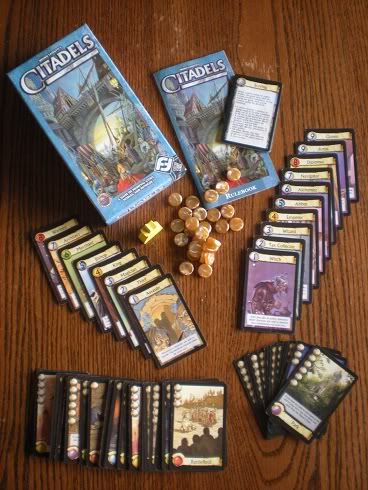
    Out of the box.
    • 66 District Cards
    • 8 Character Cards
    • 8 Reference Cards
    • 30 Plastic Gold Coins
    • A Nifty "King-Shaped" Wooden Pawn
    • 10 Bonus Character Cards (Dark City Expansion)
    • 14 Bonus District Cards (Dark City Expansion)
    The components are very nice.  The cards are a heavy, linen-textured stock.  The district cards should hold up very well over time.  However, the role cards will see heavy wear as they are routinely shuffled and handled a lot in this game.  You will either need to sleeve them or be very gentle, especially as any distinguishing marks or scuffs may jeopardize the identity of a particular card, thus diminishing the point of the secret role selection mechanic.  I've told my kids that if they bend or crease one, there will be no ice cream in the house for two months - the money instead going toward a new copy of the game!  The artwork is expressive and eye-catching.  The butterscotch buttons are fun to handle as gold.  And the wooden crown marker is a polished, if unnecessary, touch.

    The Quick Rundown:

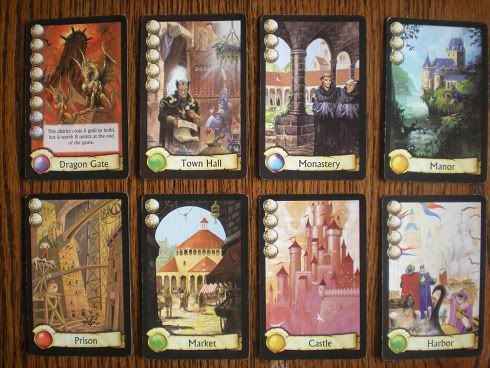
    The goal in Citadels is to have the most points when you or some one else builds eight districts, triggering the last round of the game.  You start with a hand of four district cards and two gold.  Each turn, you take an action of either a) taking two gold or b) drawing two district cards, adding one of them to your hand.  To build a district, you must pay the cost indicated on the card, which is also how many points that district is worth at the end of the game.  You can score bonus points by being the first to build eight districts, completing eight districts in the last round of the game, building at least one of the five different kinds of districts (military, royal, religious, economic, and special), and finally with certain special district cards.

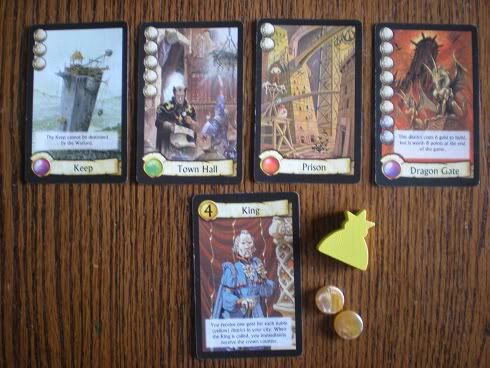
    A starting hand.
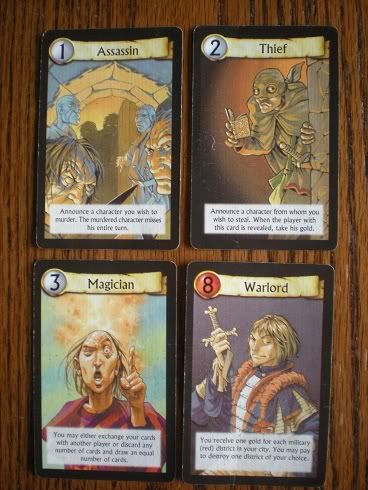
     The brilliance of this game, however, is in the character cards.  Each round, via a drafting mechanic, the players secretly select a role which will give them a special ability that turn.  The Assassin can kill another character, depriving them of their turn.  The Thief can steal a character's gold.  The Magician can trade cards with the draw pile or another player.  The King gets extra gold for each royal district you own, plus first choice of roles on the next round.  The Bishop gets extra gold for any religious districts you own, and cannot be attacked by the Warlord.  The Merchant gets an extra gold, plus more gold for any economic districts you own.  The Architect draws and keeps two extra cards and can build up to three districts if you have the money. And the Warlord receives extra gold for each military district you own, plus may destroy another player's district for the cost of one less gold indicated on that card.  The bonus characters replace certain roles from the core game and have similar abilities along the lines of their counterparts.

    A completed city worth 34 points.


    E for Everyone:

    Is a character-selection game in which half the roles can mess with you in some fashion good for kids?  I'm going to go out on a limb and say, "Yes," although it could be borderline for some.  And I actually add that caveat not because of the spite factor, but rather because of the subtlety of the psychology involved.  The beauty of this game is in balancing your role selections.  Do you simply choose the role needed for an immediate task?  Do you grab one that you think another player is after, in order to deny it to them?  Do you pick one of the "attacking" roles just to be ruthless and cruel or set someone down a notch?  Do you nab one because you think another player that's after you won't think you would select that character, hoping they will choose the wrong character to kill or steal from?  This mental head-game makes Citadels tick with intrigue and tension.  Most of the time, my kids seems to understand the psychology of this role selection and play it well - you can almost see the gears turning inside their brains.  Every now and then, they miss a subtlety that an adult would not, especially after seventh districts are built.  At that point, as the game could end in any round, there is a slightly different dynamic to the nuances of role selection.

    The direct interaction could always pose some tears among children.  After all, I've read reviews from adults that don't play this game because they're put off by that mechanic.  However, I would argue it should not be a problem for the majority of kids for two reasons.  One, it isn't too personal.  The Assassin and the Thief must pick a character to kill and steal from, not a specific player.  While the Magician can "steal" your hand, it's not as common and can even help you sometimes.  The Warlord can be a pain because he can destroy one of your districts, but you take some solace in the fact that it costs him gold (incidentally that means it's usually of lower point value so he does not have to pay as much to burn it).  All in all, this minimizes the ability to "gang up" on some one.  And two, the jabs are not constant.  This is no war game, so generally the spite is not coming relentlessly like a UFC beatdown.  You will have just as much opportunity to use the "attacking" roles as any other.  And revenge is sweet indeed!

    Beware these shady looking characters.
     The game should appeal to most kids.  The older the better.  However, 3 of my 4 kids are under the suggested age printed on the box and do just fine, by and large.  Citadels is probably our most played game.  The rules are easy to learn and play, while the psychological aspect tacks on a fun, tense, and challenging metagame.  At the same time, it is just light enough to ease the pain of the "take that" moments.  The production quality is good.  You'll be laughing as you snatch a pile of gold from underneath another's nose one turn, or as you're keeling over in your soup and bread from a dagger in your back the next.  Unless you're the type that loathes having your life and money taken from you.  Plus, it's not a strategy game, if that's what you'd rather play.  If you don't draw good district cards, it's going to limit what points you'll earn.  If you're solely into theme, you'll probably want to concentrate elsewhere.  While the character abilities make sense, the theme of nobles building a medieval city is just sort of "there," and doesn't shape any narrative.  And some of the bonuses provided by special district cards have little to do with the name of that particular district.  It does not scale as well as some would like, ideally suited more for 5-7 players (personally I still enjoy 2-3 player games).  A final, minor point is that game times do vary widely from play to play, depending on number of players and the success rate of trying to "slow down" the leader with attack cards.

    Okay, I'll Shut Up Now:

    On the Board Game Geek rating scale, I give this game a 10 (Outstanding. Always want to play and expect this will never change).  So far, the only 10 of our, as now, small collection.  Because of the nasty side and the mind games, it may not be the first game you'll use to introduce this hobby to kids and non-gamers, but it could easily be a second.